Apple's First AI Wearable Finally Comes Into Focus
On April 12, 2026, Bloomberg's Mark Gurman dropped the most detailed look yet at Apple's upcoming AI glasses — a product the company has been prototyping for years, now solidifying into something real. The Power On newsletter confirms Apple is actively testing at least four different frame designs for the device, internally codenamed N50, with production targeting December 2026 and a public consumer launch in spring or summer 2027.
And the headline takeaway is not what most Apple watchers expected: there is no display.
N50 is not an augmented-reality headset. It is not a shrunken Vision Pro. It is Apple's answer to the Meta Ray-Ban AI glasses — a pair of camera-and-microphone glasses that relies on voice, AI, and iPhone integration rather than pixels in your field of view. For developers, that pivot reshapes the ambient-AI landscape entering 2027.
The Four Designs Apple Is Testing
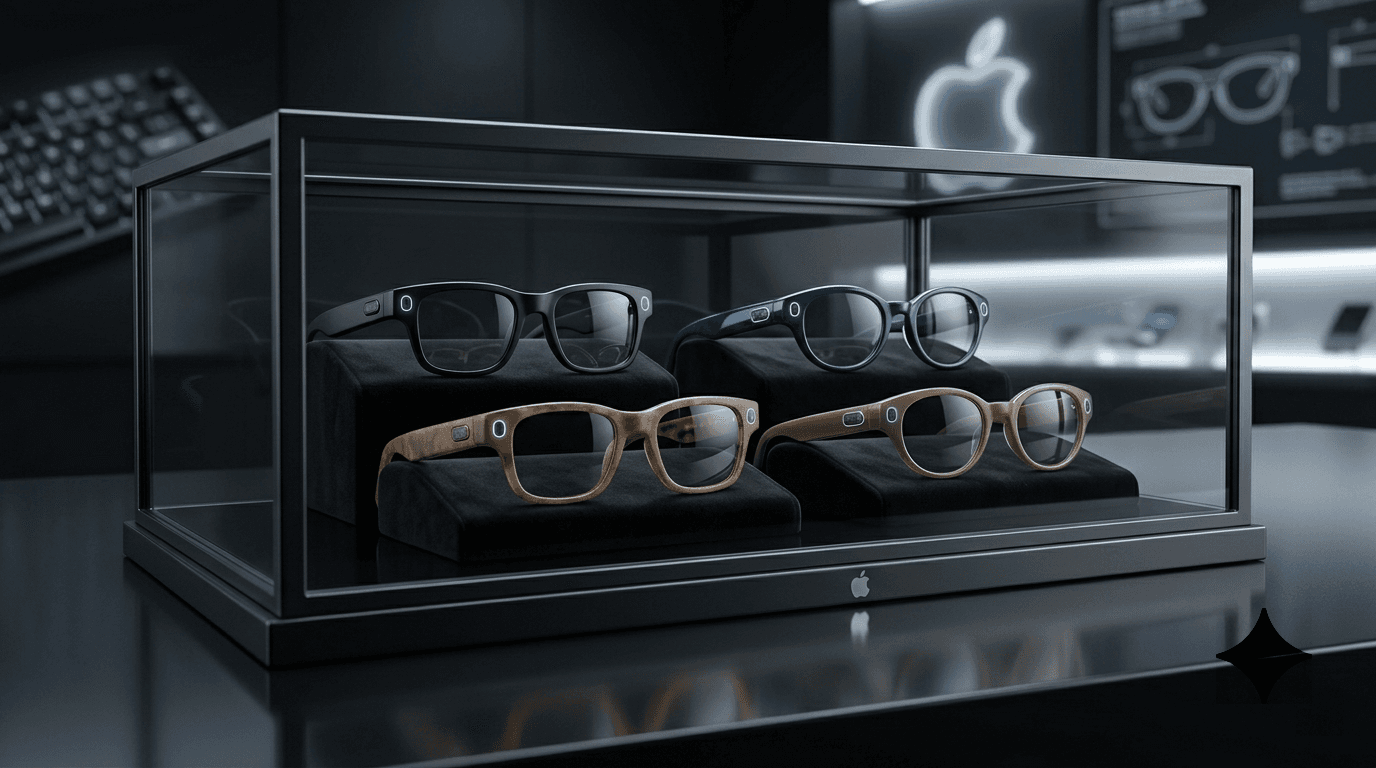
According to Gurman's reporting (corroborated by 9to5Mac, Tom's Guide, and Bloomberg), Apple is prototyping four distinct frame styles:
- Large rectangular frame — the Ray-Ban Wayfarer-style look that Meta popularized
- Slimmer rectangular frame — similar to the glasses Tim Cook actually wears
- Large oval / circular frame — the retro round lens shape
- Small oval / circular frame — a more delicate version of the round design
The body material is acetate, the same plant-based polymer used in Ray-Ban, Oliver Peoples, and high-end eyewear — chosen for durability and a "luxurious" feel, not the flimsy plastic of cheaper smart glasses. Colors tested so far include black, ocean blue, and light brown.
Apple's internal ambition, per the report, is nothing less than an "icon" — a design as instantly recognizable as the AirPods silhouette or the Apple Watch squircle.
No Display: Why Apple Is Skipping AR for Now
This is the most interesting strategic choice in the entire project.
Apple has the most advanced consumer AR hardware on the planet in the Vision Pro. It has spent years researching micro-displays, optical combiners, and waveguides. And yet the first mainstream Apple glasses will have zero pixels — no projected UI, no floating notifications, no AR overlay on your field of view.
Instead, N50 leans on:
- Two cameras: one for high-resolution photos and video, one for computer-vision AI tasks (similar to what Vision Pro uses for spatial tracking)
- Vertically oriented oval camera lenses with LED indicator lights — visually distinct from Meta's circular camera layout
- Built-in microphones and speakers for calls, audio, and voice assistance
- Tight iPhone pairing for compute, data, and most features
Why skip the display? Three reasons converge:
- Battery life. The smallest, lightest micro-displays still cost 30–50% of available power budget. A display-less pair of smart glasses can last a full day; a display-equipped pair measured in hours.
- Weight and heat. Acetate frames with cameras and speakers can stay close to regular-glasses weight. Adding a display and optical combiner pushes the device into Vision Pro territory — great for $3,500 niche hardware, wrong for mass-market eyewear.
- Meta's data. Ray-Ban Meta glasses — also display-less — sold 7 million units in 2025 and are on track for 20 million in 2026. The market has demonstrated it wants voice + camera + AI, not AR overlays. Apple is following the user demand, not the technology it could ship.
The displayed Apple glasses (long-rumored AR product) still exist on Apple's roadmap — but they are now explicitly after N50, not before.
Siri + Apple Intelligence: The Real AI Bet
With no screen to tap and no display to read, the entire interface is voice-first. That means the glasses live or die by Siri — and Siri is Apple's biggest AI weakness.
The plan, per Bloomberg and reporting by Meta Muse Spark watchers, involves:
- Upgraded Siri as the primary input — ask questions, capture images, place calls, play music, get notifications read aloud
- Apple Intelligence visual features — camera-based contextual queries ("what is this building?", "translate this menu", "read me this text")
- Ambient AI — the model sees what you see and can proactively offer information
This is the same playbook Meta runs with its AI (and GPT-5.4's computer-use model pushes on desktop): camera + multimodal model + voice interface. The difference is that Apple's Siri, as of April 2026, is still famously unreliable — the "smarter Siri" promised at WWDC 2024 has been delayed multiple times.
Whether N50 ships with a genuinely competitive AI assistant by summer 2027 is the single biggest question hanging over the entire project.
The AI Leadership Shakeup: Giannandrea Out
The glasses news landed the same week Apple quietly closed the book on its previous AI era.
John Giannandrea — the former Google Search and AI chief Apple poached in 2018 to lead Machine Learning and AI Strategy — is leaving Apple. After announcing his retirement in December 2025 following the failed Siri overhaul, Giannandrea transitioned to an advisor role earlier in 2026 and his last week at the company is mid-April 2026.
The reshuffle:
- Craig Federighi (head of Software Engineering) has taken over AI efforts more directly
- Amar Subramanya — a veteran of Google Gemini — joined Apple as VP of AI in late 2025, reporting to Federighi, leading Apple Foundation Models and AI safety
- Senior executive oversight has been redistributed across the leadership team
The timing is loaded. Apple is betting the ranch on AI hardware (glasses, next-gen AirPods with cameras, a rumored camera pendant) just as it restructures its AI organization. The gap between Apple's AI ambitions and its current AI execution is the clearest risk in the N50 story.
Apple vs Meta vs Everyone: The 2026–2027 AI Glasses Race
N50 does not enter an empty market. The AI-glasses category is suddenly crowded:
| Product | Status | Positioning |
|---|---|---|
| Ray-Ban Meta (Gen 2/3) | Shipping, ~7M sold in 2025 | Affordable, proven, developer-accessible |
| Meta Muse Spark | Just launched | Proprietary AI, closed ecosystem |
| Apple N50 | Prototyping, public reveal late 2026 | Premium design, iPhone tight-integration, acetate/luxury |
| Google AI glasses | 2026 announcement expected | Gemini-powered, Warby Parker / Gentle Monster partners |
| Snap Spectacles (next-gen) | In development | Creator/camera-focused |
| Xiaomi / Huawei AI glasses | Shipping in China | Budget tier, regional |
Meta has the volume. Google has the partnerships and AI model. Apple has the design cachet and tight hardware-software integration. For the first time in nearly a decade, Apple is entering a product category second or third to market — the same position it occupied with the iPod, iPhone, and Apple Watch, where arriving late with a better-executed product has historically worked out fine for Cupertino.
What This Means for Developers
For the DevPik audience, the N50 story matters on three fronts:
1. A New App Paradigm (Eventually)
Camera + AI + voice = an entirely new interaction surface. If Apple opens developer APIs for glasses features — visual search, real-time translation, contextual reminders, live-caption overlays for AirPods — a new app category emerges. Developers who were early to Apple Watch complications, Live Activities, and Vision Pro spatial apps will be the ones building first for glasses.
Apple has already hinted at an "App Store-like platform approach" for AI features. Whether that extends to N50 on day one or later is still unknown.
2. The Privacy and Consent Problem
Always-on cameras on your face create instant privacy concerns — for the wearer, the people around them, and the data that gets captured and processed. Meta's Ray-Ban glasses have already triggered debates about recording in public spaces, consent, and persistent surveillance.
Apple will lean on its privacy-first brand positioning, LED capture indicators, and likely on-device processing. But the fundamental social norms around "AI glasses in a coffee shop" are unresolved, and developers building on the platform will be building inside that unresolved debate.
3. The Vision Pro Lesson
Vision Pro shipped ~390,000 units in 2024 and the rate collapsed afterwards — production was halted, marketing cut by 95%, and the dedicated Vision Products Group was folded into the standard hardware division. Expensive hardware + limited developer adoption = slow start.
N50 is Apple's correction. By starting with a display-less product closer to $500–$800 (early estimates) instead of $3,500, Apple can chase the ~300 million Americans who wear corrective lenses — a market 100x larger than the premium-AR headset niche. Developers who went all-in on Vision Pro in 2024 learned a hard lesson about Apple hardware launches; N50's consumer scale is designed to avoid that.
Timeline: What Happens Next
- April–November 2026 — Active prototype testing with the four frame designs
- December 2026 — Production begins for launch-year units
- Late 2026 — Public reveal (likely at a special Apple event, not WWDC)
- Spring/Summer 2027 — Consumer launch
- Developer SDK — Timing unclear; if Apple follows the Vision Pro playbook, expect visionOS-style glasses frameworks announced at WWDC 2027
In the meantime, Meta will ship a Ray-Ban Gen 3 and likely hit the 20-million-units-per-year pace. Google will announce its glasses. And Apple will keep tightening Siri — because if Siri cannot hold its own by summer 2027, no amount of acetate and oval cameras will save the product.
The Bigger Picture
N50 is the clearest signal yet that ambient AI — models that see, listen, and assist continuously — is the next major consumer-hardware front. The iPhone redefined mobile, the Apple Watch redefined wearables, and the AI glasses category (Apple's, Meta's, Google's) may redefine what personal computing looks like when it is not held in your hand.
For now, the iPhone still does most of the work. N50 is a voice-and-camera accessory to the phone, not a replacement for it. But the groundwork — camera APIs, Apple Intelligence, improved Siri, on-device AI acceleration — is all heading toward a world where the glasses are the computer.
Whether Apple gets there before Meta or Google is the question of the next 18 months.
While Apple prepares AI for your face, DevPik keeps AI-powered convenience in your browser — no wearable required. Try our 46+ free developer tools including the full Developer Tools suite and CSS Tools collection. For more on the AI hardware race, see our coverage of Meta Muse Spark, GPT-5.4 Computer Use, Claude Mythos, OpenClaw, and the Claude Advisor Strategy.
Sources & Primary References
- Apple Newsroom — Apple's official channel for hardware announcements, including any eventual product reveal for the N50 family.
- TechCrunch Apple coverage — independent reporting on Apple's AI and wearables strategy.
- 9to5Mac — Apple rumors and leaks — long-running Apple-focused publication covering supply-chain leaks and prototypes.
- Bloomberg's Mark Gurman Power On newsletter — an authoritative supply-chain source frequently cited in Apple product reporting.