One OAuth click, half of Web3''s frontends on fire
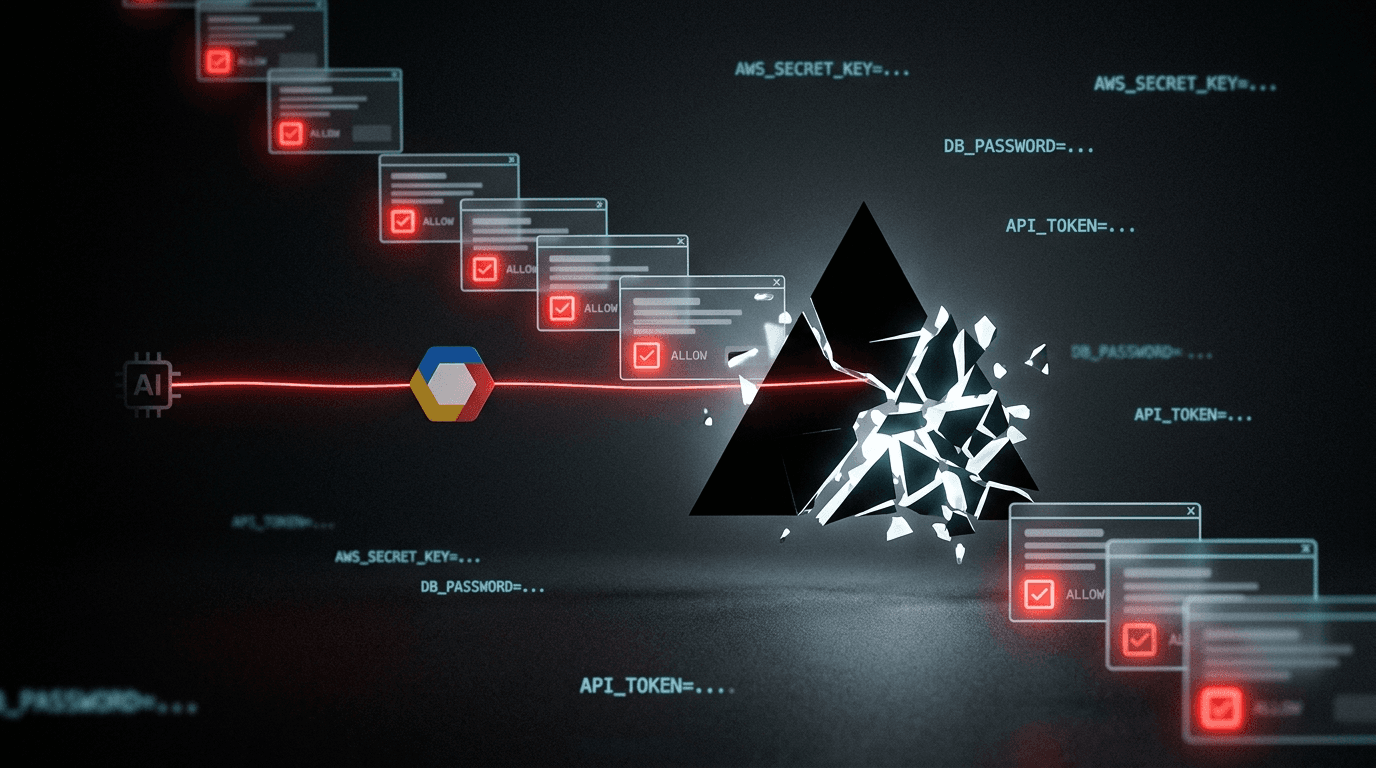
The breach began, as these things always do, with a convenience. A Vercel employee signed up for Context.ai — a third-party AI office suite — using their enterprise Google Workspace account. When the OAuth consent screen asked for scopes, they clicked "Allow All."
On April 19, 2026, Vercel disclosed that an attacker had pivoted through that consent screen into the employee''s Google Workspace account, and from there into Vercel''s internal environments. By the time CEO Guillermo Rauch was posting clarifications on X, Orca — one of the largest Solana DEXs — had already rotated every deployment credential they owned. DeFi Twitter was in full panic. A threat actor using the ShinyHunters persona was posting on BreachForums asking $2M for the alleged haul.
And all of it traces back to a scope grant.
The chain, verified
Here is what Vercel has confirmed, and what public reporting has stitched together:
- The foothold. Per Hudson Rock, a Context.ai employee was infected with Lumma Stealer in February 2026. That is the most plausible origin of the OAuth app compromise.
- The pivot. The attacker used Context.ai''s OAuth token to access the Vercel employee''s Google Workspace account. The grant was "Allow All" — Gmail, Drive, Calendar, and anything else the app was permitted to request.
- The escalation. From the compromised Workspace account, the attacker enumerated Vercel''s internal environments.
- The read. A limited subset of customer environment variables were read — only the ones not marked as
sensitive. Sensitive-flagged values are encrypted at rest; Vercel says there is no evidence those were accessed. - The IOC. Vercel has published the malicious OAuth app''s client ID:
110671459871-30f1spbu0hptbs60cb4vsmv79i7bbvqj.apps.googleusercontent.com. If you run a Google Workspace tenant, search your audit logs for it.
What was not touched, per Rauch: Next.js source. Turbopack. The open-source supply chain. This was a data exposure, not a supply-chain injection. That distinction matters a lot, and it will keep getting blurred in the next seven days of coverage.
''Allow All'' is not consent. It is abdication.
The decision that made this breach possible is not the Lumma Stealer infection or the Context.ai compromise. It is the single-click OAuth grant.
Every third-party AI SaaS launching right now — every "let our agent read your inbox and draft replies" startup — is asking the same question on the same consent screen: give me Gmail, Drive, Calendar, Contacts, Docs. Users click through. The scopes are broad, the explanations are thin, and the default enterprise posture is to treat OAuth grants as browser permission dialogs instead of what they actually are: long-lived API keys to your identity.
If you are running a Google Workspace tenant, here is the uncomfortable truth: you probably do not know how many third-party apps your employees have connected to it right now. You probably cannot name them without opening the admin console. And once one of those apps gets popped — and they do, constantly — the blast radius is whatever scopes were granted, times however long the refresh token has been sitting there.
Restrict third-party app access. Require admin review for any app requesting sensitive scopes (gmail.modify, drive, anything on Google''s restricted-scope list). If you already have App Access Control set to "Trusted" apps only for Gmail and Drive, you were already further ahead than Vercel was on April 18.
ShinyHunters, the $2M ask, and the attribution problem
Within hours of Vercel''s disclosure, a threat actor using the ShinyHunters persona posted on BreachForums offering what they described as Vercel internal database dumps, source code, NPM tokens, and GitHub tokens — for $2 million.
The proof they shared: 580 Vercel employee records (names, emails, status, timestamps) and a screenshot of what appears to be an internal Enterprise dashboard. That is real, but it is thin. Employee directories leak from a lot of places — including from any tool that can read a Google Workspace org, which is exactly the access this attacker had.
Here is where it gets murky. ShinyHunters-linked actors have denied involvement in comments to BleepingComputer. "ShinyHunters" is less a group than a persona passed around the breach-forum ecosystem; attribution to it tells you almost nothing about who is actually holding the data. Vercel has engaged Mandiant and law enforcement. Assume no public confirmation of the full scope or contents until those investigations surface something more substantive than a forum post.
Until then: the specific claim of NPM tokens and GitHub tokens is the scariest part, and also the least verified part. That is the exact shape a threat actor would describe if they wanted maximum ransom leverage, whether or not it is true.
Blast radius: why DeFi frontends rotated everything
Most of the customer reaction has come from Web3.
Orca, one of the largest Solana DEXs, publicly rotated all deployment credentials within hours. Their statement was careful: user funds and on-chain state are safe — those live on Solana, not on Vercel. What sat on Vercel was the frontend. The thing users actually interact with. The thing that, if an attacker swapped out the JavaScript bundle, could start signing drainer transactions on every wallet that connected.
That is the specific fear that swept DeFi Twitter on April 19. It is also the specific thing that the Vercel disclosure, as written, does not describe happening. The incident was an environment variable read — not a build-pipeline hijack, not a deploy-token replay. But the rotation cascade is the right move anyway: if you host a financial frontend on a platform that just had its internal environments enumerated, you rotate. You do not wait for certainty. You do not read three forum threads first.
The larger lesson: Web3 frontends have centralized on Vercel and Cloudflare Pages the same way Web2 centralized on AWS. That is a speed and DX win and a systemic-risk loss. When the frontend host has a bad week, every wallet-facing UI inherits the blast radius.
The sensitive-env-var toggle you should have already flipped
Vercel has a feature that, on April 19, quietly became the difference between "our keys leaked" and "we''re fine."
When you add an environment variable in the Vercel dashboard, there is a checkbox labeled Sensitive. Values marked sensitive are encrypted at rest and are not displayed in the UI after creation. Non-sensitive values are stored in a way that plaintext read access is possible for anyone with sufficient internal access — which is exactly the access the attacker got.
Vercel''s own statement: no evidence sensitive-flagged variables were accessed. Non-sensitive ones, for a limited subset of customers, were. If your database URL, Stripe secret key, OpenAI API key, or any other credential is currently sitting in Vercel without that checkbox, go fix it before you finish this article.
You also want to rotate anything that was non-sensitive during the affected window. Vercel should be notifying affected customers directly; as of this writing, the Hacker News thread is full of Vercel users complaining they have not gotten an email yet. Check your Vercel team audit logs. Do not wait for the notification to land.
The SaaS-AI permission creep problem
Zoom out and this is not really a Vercel story. It is a story about what happens when every developer''s workflow depends on granting broad OAuth scopes to twenty AI SaaS products that did not exist eighteen months ago.
Context.ai is not a fringe tool. It is the sort of AI office suite that shows up in funding announcements. Its OAuth app was, presumably, reviewed. Its employee — per Hudson Rock — got hit with commodity infostealer malware. That is not an exotic threat. That is the most ordinary breach vector in existence. Lumma Stealer, Redline, Vidar — these are sold by the month. The bar for getting popped by one is very low.
The question for every developer reading this is not "is my OAuth-connected AI tool going to get breached." The question is "when it does, how much of my identity and my employer''s identity did I hand over when I clicked Allow All."
A workable hygiene checklist:
- Audit your Google Workspace third-party apps this week. Admin console → Security → API controls → Third-party app access. Revoke anything you do not recognize. Revoke anything you recognized six months ago and have not used since.
- Never grant enterprise SSO to personal-tier AI tools. If a tool does not have an enterprise tier with SSO, SCIM, and scope restriction, it does not get your work account.
- Prefer narrow-scope apps.
gmail.readonlyis survivable.gmail.modifyplusdriveis a catastrophe. - Set Workspace to admin-approved apps only. The friction is real. The alternative is Vercel''s week.
- Flip every Vercel env var to Sensitive. Nothing about this should have been optional. Until the default changes, you do it yourself.
What to watch next
A few things are still in motion:
- Vercel''s detailed postmortem. Expected in the next week or two. The interesting parts will be how long the OAuth token had access, what internal detection missed it, and whether any customer was notified late.
- The ShinyHunters data drop. If the $2M is not paid — and it almost never is — the data typically leaks to BreachForums within 7–14 days. Whatever appears there is the real scope, not the press-release scope.
- Google''s response on OAuth scope defaults. This incident is a stress test of "Allow All" as a UX pattern. If Google tightens default scopes or adds friction to broad grants, that is the most durable positive outcome of the breach.
- The DeFi-frontend migration conversation. Some protocols are already discussing moving frontends to IPFS or decentralized hosting. Most will not, because centralized hosting is too convenient. The ones that do are a useful leading indicator of where Web3 infrastructure is actually going.
If you run anything on Vercel, the action items today are: flip your env vars to sensitive, rotate the ones that were not, audit your Google Workspace third-party app grants, and search your audit logs for the published IOC. Everything else can wait for the postmortem.
Pasting a credential to check something? Use DevPik''s [free developer tools](https://devpik.com) — encoders, JSON formatters, and text utilities are 100% client-side. Nothing leaves your browser.
Sources & references
- Vercel — Guillermo Rauch''s security disclosure and follow-up posts on X and vercel.com, April 19–20, 2026.
- Hudson Rock — report identifying a Context.ai employee infected with Lumma Stealer in February 2026.
- BleepingComputer — coverage of the ShinyHunters BreachForums listing and the group''s denial of involvement.
- Hacker News — discussion thread with customer-notification complaints and Vercel-side clarifications.
- Orca — public statement on credential rotation and on-chain fund safety.
- Vercel documentation — "Sensitive Environment Variables" feature reference.
- Google Workspace admin documentation — third-party app access controls and API controls settings.
- Mandiant — engaged for incident response; no public findings as of April 20, 2026.