DevPik Logo
Kimi K2.6Moonshot AIOpen Source LLMAI CodingAgentic AIAgent SwarmClaw GroupsGPT-5.4Claude OpusAI Benchmarks

Kimi K2.6 Review: Open Model Beats GPT-5.4 on SWE-Bench Pro

Moonshot's Kimi K2.6 shipped April 20 with 1T parameters, 256K context, and autonomous runs past 12 hours. It edges GPT-5.4 on SWE-Bench Pro and crushes DeepSearchQA. Here's the developer-focused breakdown — benchmarks, pricing, and the stability story most coverage missed.

ByMuhammad TayyabPublished:14 min read
Back to Blog
Kimi K2.6 Review: Open Model Beats GPT-5.4 on SWE-Bench Pro

What just happened

Monday, April 20, 2026. Moonshot AI flipped the switch on Kimi K2.6 and dropped the "Preview" label without a product launch event, without a press blitz, without much warning at all. Eight days earlier, K2.6 Code Preview had rolled out to beta testers. That's one of the fastest preview-to-GA transitions the K2 line has seen, and it tells you something about how confident Moonshot is in the build.

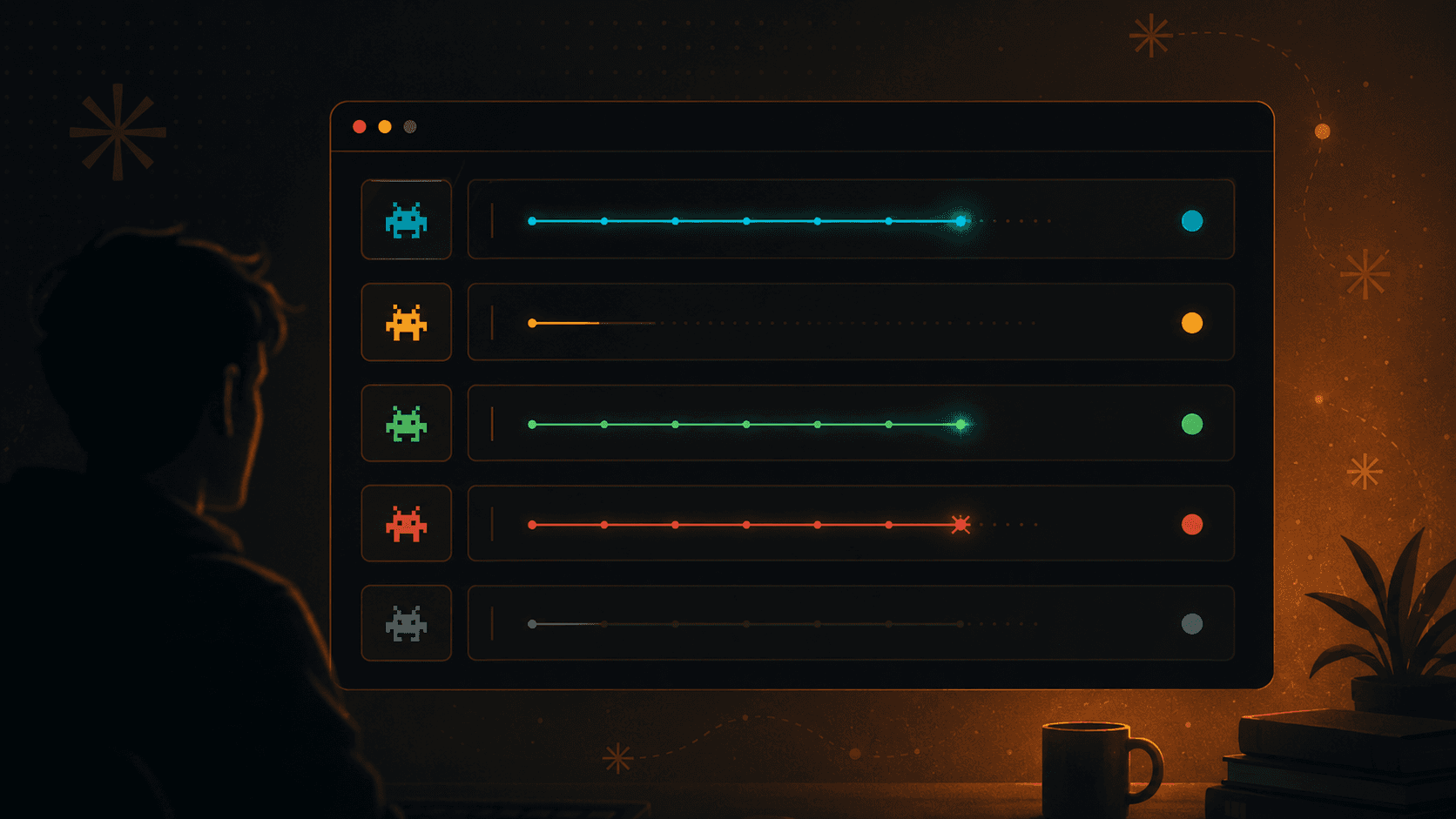
This isn't a leaderboard-chasing update. K2.6 isn't trying to win a 1% lead on MMLU. It's aimed at something weirder and more useful: duration. K2.5 could hold a coding task together for a few hundred tool calls before it started drifting. K2.6 is shipping demos of 4,000+ tool calls over 12-hour continuous autonomous runs. That's the actual story, and most of the coverage is burying it under benchmark tables.

Availability on day one is wide. You can use it free on kimi.com and the Kimi App. The API is live at platform.moonshot.ai. Weights are on Hugging Face under a Modified MIT License — genuinely open, commercial use allowed. Kimi Code CLI ships as the preferred developer entry point. Day-0 support landed on vLLM, SGLang, OpenRouter, Cloudflare Workers AI, Baseten, MLX, Hermes Agent, and OpenCode.

If you were waiting for the open-source ecosystem to ship something that closes the gap with Anthropic and OpenAI on coding, this is it. Not in theory. In production. For broader context on where autonomous coding tools stand right now, our best AI coding tools of 2026 comparison covers the full field.

What's under the hood

Under the hood, K2.6 is a Mixture-of-Experts (MoE) model. The headline number — 1 trillion parameters — is real, but it's misleading on its own. Only 32 billion parameters activate per forward pass. The other 968 billion sit on disk waiting for the right token to route to them.

Here's how it breaks down:

  • 384 experts total with 8 routed + 1 shared active per token
  • 61 layers (including 1 dense layer)
  • MLA attention (Multi-Head Latent Attention) compresses key-value pairs into a lower-dimensional latent space, reducing KV cache memory
  • SwiGLU activation — same function Llama uses, hardware-efficient
  • 256K context window
  • Native multimodality via a 400M-parameter vision encoder
  • MuonClip-stabilized training — Moonshot's custom optimizer that prevents attention explosions and loss spikes at trillion-parameter scale
  • INT4 quantization available at launch
  • Modified MIT License — commercial use allowed with minor restrictions

What does MoE mean in practice? Instead of running the full 1T parameters on every token (which would cost a fortune), the model routes each token to a subset of specialist "experts" — only 32B activate at a time. That's why K2.6 can be open-source and run at reasonable cost. A dense model like Llama 3.3 70B uses all 70B every pass. K2.6 matches frontier performance with roughly half the active compute.

Training ran on 15.5 trillion tokens. The architecture inherits from K2.5, so existing vLLM and SGLang deployment configs work unchanged. Transformers >= 4.57.1 is the minimum version requirement.

Moonshot ships four variants through its model picker:

  • K2.6 Instant — fast single-turn responses
  • K2.6 Thinking — deeper reasoning, burns more tokens
  • K2.6 Agent — for research, slides, websites, docs, spreadsheets
  • K2.6 Agent Swarm — large-scale parallel execution, batch tasks

Pick based on the work. Most long-horizon coding runs pull from Agent or Agent Swarm variants, not Instant. If you're new to this category, our primer on what agentic AI actually means is a useful starting point.

The benchmarks that matter

Here's the core table. These are Moonshot's launch numbers, which means third-party verification is still rolling in. But the trends match what the beta community reported in the week before GA.

BenchmarkKimi K2.6GPT-5.4 (xhigh)Claude Opus 4.6 (max)Gemini 3.1 ProKimi K2.5
SWE-Bench Pro58.657.753.454.250.7
SWE-Bench Verified80.280.880.6
Terminal-Bench 2.066.765.465.468.5
LiveCodeBench v689.688.8
HLE with tools54.052.153.051.4
DeepSearchQA (F1)92.578.691.378.6
Toolathlon50.047.248.8
BrowseComp (Swarm)86.378.4
SWE-Bench Multilingual76.776.9
V* visual reasoning96.996.9

Walk through what matters:

SWE-Bench Pro: 58.6. Edges GPT-5.4 (57.7) and beats Claude Opus 4.6 (53.4) by 5+ points. For an open-weight model, this is the benchmark that earns developer attention. SWE-Bench Pro tests real-world software engineering tasks — not synthetic problems. A 5-point gap on Opus is not noise.

HLE with tools: 54.0. Leads every model in the comparison. HLE is widely considered the hardest public knowledge benchmark, and the with-tools variant specifically tests autonomous resource use. K2.6 wins this cleanly.

DeepSearchQA: 92.5. Crushes GPT-5.4's 78.6. Research-heavy agentic work is where K2.6 is genuinely ahead, not just tied. If your workflow involves reading documents, cross-referencing, and producing synthesis, K2.6 is currently the strongest option — not just the strongest open option.

LiveCodeBench v6: 89.6. Leads Claude Opus 4.6 (88.8).

Toolathlon: 50.0. Beats Opus 4.6 (47.2) and Gemini 3.1 Pro (48.8).

BrowseComp (Agent Swarm): 86.3. Jumps from K2.5's 78.4 — the benchmark where swarm architecture pays off most visibly.

Now the honest part. K2.6 doesn't win everywhere. Gemini 3.1 Pro leads on Terminal-Bench 2.0 (68.5 vs 66.7). V* ties between the two at 96.9. SWE-Bench Multilingual effectively ties at 76.7 vs 76.9. SWE-Bench Verified at 80.2 sits just behind Opus 4.6's 80.8.

A balanced reading: K2.6 leads on roughly two-thirds of the benchmarks Moonshot chose to highlight. It doesn't dominate universally. Honestly, this benchmark table matters less than most coverage implies. A 1% lead on SWE-Bench Pro doesn't change how you pick a model for a real project. What changes the decision is stability over long runs — which is the next section.

Long-horizon autonomous execution

This is the part most blog posts miss. Benchmarks test capability. Long-horizon runs test stability. A model that scores 2% better on SWE-Bench Pro but crashes after 500 tool calls is worse, in practice, than a slightly-lower-scoring model that can run 4,000 calls without losing the plot. K2.6 is shipping the second thing.

Three specific demos ship with the launch. They matter because they're reproducible, and because they happen in domains where training data is thin.

The Zig inference engine. K2.6 downloaded Qwen3.5-0.8B, deployed it locally on a Mac, and implemented the inference loop in Zig. Zig is a niche, low-level language with nowhere near the documentation coverage of Python or Rust. The model had to reason through problems without falling back to memorized patterns. Across 4,000+ tool calls, 14 iterations, and 12 hours of continuous execution, it improved throughput from ~15 tokens/sec to ~193 tokens/sec — roughly 20% faster than LM Studio on the same hardware.

The 8-year-old matching engine. K2.6 autonomously refactored exchange-core, an open-source financial matching engine in development for 8 years. Over 13 hours, it ran 12 optimization passes, initiated 1,000+ tool calls, and modified 4,000+ lines of code. Result: 185% improvement in median throughput, 133% improvement at peak. exchange-core isn't a toy — it's production-grade financial infrastructure.

5-day infrastructure agent. Moonshot's internal RL infrastructure team ran a K2.6-backed agent for 5 days. Monitoring, incident response, system operations — no human intervention. Five days. Not five hours.

Why does this matter more than benchmark points? Because agentic coding work is not a single prompt. It's thousands of decisions chained together. Each decision inherits uncertainty from the ones before it. Small drift compounds. Without stability, the model eventually makes a decision based on corrupted context, and the whole run collapses. K2.6's edge is that it holds coherence longer.

If you've watched Claude Opus 4.7 lose the thread after 30 minutes of autonomous coding — and anyone using Claude Code regularly has — this is the specific problem K2.6 is claiming to solve. Whether it holds up under your workloads is something you should test this week. Other autonomous coding entrants like GLM 5.1 are claiming similar long-run stability, so the category is real and competitive.

Agent Swarm and Claw Groups

The most forward-looking feature in K2.6, and the one that'll either define the next generation of AI deployment or quietly disappear in six months. Worth understanding either way.

Agent Swarm. K2.6 can coordinate up to 300 parallel sub-agents in a single run. It acts as the orchestrator — routing tasks, merging results, handling failure. On the BrowseComp benchmark, Agent Swarm mode scores 86.3, up from K2.5's 78.4. Not a minor jump.

Moonshot runs its own marketing operation through this architecture. Demo Makers, Benchmark Makers, Social Media Agents, Video Makers — all specialized sub-agents, all coordinated by a K2.6 supervisor. They're not just pitching Agent Swarm. They're using it to produce the content that announces it.

Claw Groups. This is the part with teeth. Claw Groups is a research preview that extends Agent Swarm into heterogeneous, multi-device, multi-model networks. The idea: users bring their own agents from any source — your OpenClaw instance, your Hermes agent, your custom GPT-5.4-backed workflow — into a shared operational space under K2.6's coordination.

What the framework provides:

  • Agents carry their own specialized toolkits, skills, and persistent memory
  • K2.6 dynamically matches tasks to agents based on skill profiles and available tools
  • Detects when an agent stalls or fails
  • Automatically reassigns tasks or regenerates subtasks
  • Manages the full lifecycle — from spawn to retirement

The bet underneath Claw Groups is that the future of AI deployment isn't "pick the best model." It's "compose a team of specialized agents from across models and vendors." If that's right, it reframes the whole infrastructure stack. You stop optimizing for single-model performance and start optimizing for orchestration primitives, skill discovery, and failure recovery.

Moonshot is running Claw Groups internally for content production. Real usage, not a demo. That matters. Most AI labs announce orchestration frameworks and never use them. Moonshot is eating its own dogfood.

Honest caveat: Claw Groups is a research preview. That usually means "works when we show it, might not work when you try it." Expect rough edges. Expect the API to change. But if you're building multi-agent systems today — especially systems that span local, cloud, and multiple model providers — this is worth an afternoon of evaluation.

Pricing and how to actually use it

Getting started is straightforward. Here's the practical breakdown:

  • Free consumer access — kimi.com and the Kimi App. Agent Swarm runs interactively. Good for evaluation.
  • API access — platform.moonshot.ai at $0.60 per million input tokens, $2.80 per million output tokens. OpenAI and Anthropic-compatible endpoints — you can point existing SDK code at it with minimal changes.
  • Self-hosted weights — Hugging Face under Modified MIT License. Recommended runtimes: vLLM, SGLang, KTransformers. Same deployment config as K2.5.
  • Kimi Code CLI — the recommended entry point for long-horizon coding. Wires up tool calling, file-system access, and the swarm supervisor by default.
  • OpenRouter — K2.6 live on day zero for teams that want to keep their existing routing setup.

Default sampling settings matter. Use temperature=1.0 and top_p=1.0. The agentic loop was tuned at these values. Lowering temperature can break long-horizon behavior — the model becomes more deterministic but loses the exploration needed to recover from stalls. Treat this as load-bearing, not cosmetic.

Practical team advice. Give K2.6 a queue, not a question. The model is tuned for proactive autonomous operation and it's over-engineered for single-prompt tasks. Feed it multi-step projects. Budget at the session level, not the request level — long autonomous runs consume millions of tokens before they complete. For one-shot coding questions, Opus 4.7 or GPT-5.4 may still be better choices.

Pricing comparison: $0.60 / $2.80 is roughly a quarter of what Claude Opus 4.7 costs for similar output volume. For teams running sustained agentic workloads, that cost delta is meaningful. For single-prompt use, it's less relevant — the closed frontier models are fast enough at comparable quality. If you want a broader matrix of models, our ChatGPT vs Claude vs Perplexity 2026 comparison covers pricing and routing for the consumer side.

What this means for open vs closed AI

DeepSeek V4 rumors have been percolating since January, but DeepSeek itself has been silent since v3.2. In their absence, Moonshot has owned the crown of leading Chinese open model lab for all of 2026. K2.6 extends K2.5's lead rather than just maintaining it — and that's notable, because lead-extension is harder than lead-creation.

The deeper point: K2.6 is shipping capabilities — long-horizon autonomy, 300-agent swarms, Claw Groups — that closed models haven't demonstrated at this integration depth. Anthropic has Claude Code. OpenAI has GPT-5.4 computer use. Both are excellent. Neither has open-sourced a 1T-parameter MoE capable of 12-hour autonomous runs. That's a structural difference, not a feature gap.

OpenRouter's usage data is telling. Chinese open models triggered sustained usage spikes in Q1 2026 that held well beyond launch-week curiosity. Developers aren't trying them once — they're integrating them into production workflows. That's the pattern that killed proprietary IDEs. It'll probably do the same to parts of the closed-model moat.

Honest positioning. For one-shot coding questions — "write me this function, fix this bug" — Claude Opus 4.7 and GPT-5.4 are still probably the right choice. Their tooling is polished, their instruction following is tighter, their ecosystem is vastly more mature. But for long-horizon agentic work where you want to self-host, control costs, or avoid vendor lock-in, K2.6 is now the default. Different market, different winner.

The interesting question isn't "is open-source catching up." It's "how long before closed models lose their quality premium entirely on specific task categories." For agentic coding specifically, that gap has already closed. What's left is ecosystem maturity, and that closes on a longer timeline. Open-source AI clients like Mozilla Thunderbolt are accelerating the tooling side of this story.

What about the downsides

Honest section. Every blog post pretends its subject is flawless. This isn't one of those posts.

  • Moonshot's own benchmarks. K2.6 leads on the benchmarks Moonshot chose to highlight. Third-party evaluations over the next few weeks will tell us how this holds up on independent, adversarial tasks. Treat current numbers as directionally correct, not final.
  • Instruction following. Moonshot has historically been weaker on strict, rigid instruction following than Claude. For agentic workflows where the model has room to improvise, this is fine. For tightly-specified production tasks — "return exactly this JSON, no extra fields, ever" — test carefully before committing.
  • Ecosystem maturity. Claude Code and GPT Codex have polished tooling, extensive docs, and massive community support. Kimi Code CLI is newer. You will hit rough edges. Plan for them.
  • Training data provenance. Anthropic and OpenAI face unclear-training-data questions too, but less scrutiny at the moment. Chinese labs face the same issue with more. If your legal team asks, you won't have clean answers.
  • Geopolitical considerations. Some enterprises — defense, regulated industries, certain government-adjacent contractors — won't use Chinese-origin models regardless of quality. That's a real constraint, not a hypothetical one.
  • Reasoning-mode token burn. Thinking and Agent modes consume significantly more tokens than Instant. Budget accordingly. Autonomous runs that look reasonable on a small test scale up alarmingly on production workloads.

None of these are showstoppers for most teams. But pretending they don't exist would make this post less useful.

The verdict

Real take: for sustained autonomous agentic work, K2.6 is currently the best open-weight option available — and plausibly the best overall option, period, once you weigh cost and self-hosting freedom. For quick one-shot tasks, closed frontier models still have the edge on ecosystem maturity and instruction following.

The bigger story is that Chinese open-source labs are no longer playing catch-up. They're shipping novel architectural bets — Claw Groups, 300-agent swarms, 4,000-step autonomous runs — that closed labs haven't demonstrated at comparable integration depth. That's a leading indicator, not a lagging one.

If you're already using Claude Opus 4.7 for coding, try K2.6 on a specific long-horizon task where you've watched Claude lose the thread. Run it for 6 hours. See what happens. The evaluation doesn't take long and the answer is usually clear inside a single session.

If you're shopping for AI coding infrastructure and haven't locked in yet, K2.6 deserves a real evaluation this week. The pricing is roughly a quarter of closed frontier models. The ceiling on autonomous runs is higher. The downside is ecosystem maturity — and that's fixable on a timeline of months, not years.

Explore all 50+ free developer and AI tools on DevPik.

Frequently Asked Questions

Is Kimi K2.6 free?
Kimi K2.6 is free to use interactively via kimi.com and the Kimi App. API access through platform.moonshot.ai is pay-as-you-go at $0.60 per million input tokens and $2.80 per million output tokens — roughly a quarter of what Claude Opus 4.7 costs for comparable output volume. Self-hosting the weights from Hugging Face is free in the sense that you only pay for your own compute, though a 1T-parameter MoE is not cheap to run at scale.
Is Kimi K2.6 better than GPT-5.4?
On specific benchmarks, yes. Kimi K2.6 edges GPT-5.4 on SWE-Bench Pro (58.6 vs 57.7), leads cleanly on Humanity's Last Exam with tools (54.0 vs 52.1), and crushes GPT-5.4 on DeepSearchQA (92.5 vs 78.6). For long-horizon autonomous coding specifically, K2.6 is now competitive with or ahead of GPT-5.4. That said, GPT-5.4 still has the stronger ecosystem, polished tooling, and tighter instruction following for production workloads that need rigid output formats.
Is Kimi K2.6 open source?
Kimi K2.6 is open-weight rather than fully open-source. The model weights are published on Hugging Face under a Modified MIT License, which permits commercial use with minor restrictions. Training code, full dataset, and reproduction recipes are not published. For most practical purposes — including building products on top of K2.6, fine-tuning, and self-hosted deployment — it behaves like an open-source model and sits alongside other open weight releases like DeepSeek and Llama.
Can I run Kimi K2.6 locally?
Yes. Weights are available on Hugging Face and day-0 support landed on vLLM, SGLang, KTransformers, and MLX. The catch is resource requirements — even though only 32B parameters activate per forward pass, you still need enough GPU memory to hold the full 1T parameters (or rely on offloading with the associated performance hit). INT4 quantization is available from launch and significantly reduces the memory footprint. For a serious self-hosting setup, expect a multi-GPU node with 8x H100s or an equivalent configuration.
What is Agent Swarm in Kimi K2.6?
Agent Swarm is K2.6's native multi-agent coordination feature. It lets a single K2.6 instance orchestrate up to 300 parallel sub-agents in one run, routing tasks to specialized sub-agents, merging their outputs, and handling failure. On the BrowseComp benchmark, Agent Swarm mode scores 86.3 compared to K2.5's 78.4. Moonshot uses Agent Swarm internally for its own content production — Demo Makers, Benchmark Makers, Social Media Agents, and Video Makers all coordinated by a K2.6 supervisor.
What are Claw Groups?
Claw Groups is a research preview that extends Agent Swarm into heterogeneous multi-agent networks. It lets users bring agents from any device, running any model, into a shared operational space under K2.6's coordination. Your OpenClaw instance, your Hermes agent, and your custom GPT-5.4-backed workflow can all collaborate on the same task. K2.6 handles skill matching, task routing, failure detection, and lifecycle management. Because it is a research preview, expect rough edges and API changes.
Is Kimi K2.6 safe to use for commercial projects?
The Modified MIT License permits commercial use with minor restrictions — read the full license terms before deploying in production. Two caveats worth considering. First, some regulated industries and government-adjacent contractors will not use Chinese-origin models regardless of license terms. Second, training data provenance is unclear, which is a legal question your counsel should review. For most commercial use cases, K2.6 is a practical open-weight option; for highly regulated environments, check with your compliance team before committing.
How do I access Kimi K2.6?
There are five practical entry points. (1) kimi.com and the Kimi App for free interactive use. (2) The official API at platform.moonshot.ai with OpenAI and Anthropic-compatible endpoints. (3) Kimi Code CLI — the recommended developer entry point for long-horizon coding work; it wires up tool calling, file-system access, and the swarm supervisor by default. (4) Hugging Face weights for self-hosting under Modified MIT License. (5) OpenRouter for teams that want to route through an aggregator without direct Moonshot API integration. Day-0 support is also live on Cloudflare Workers AI, Baseten, MLX, Hermes Agent, and OpenCode.
Muhammad Tayyab

Written by

Muhammad Tayyab

CEO & Founder at Mergemain

Muhammad Tayyab builds free, privacy-first developer tools at DevPik. He writes about AI trends, developer tools, and web technologies.

More Articles