What Is Markup?
Markup is the percentage added to the cost of a product or service to determine its selling price. It answers a simple question: how much more than cost are you charging?
The markup formula is:
Markup % = ((Selling Price - Cost) / Cost) × 100
For example, if a product costs $50 to produce and you sell it for $75, the markup is (($75 - $50) / $50) × 100 = 50% markup.
Markup is cost-based — it always uses the cost price as its denominator. This makes it the go-to metric for pricing decisions because it starts from what you know: your cost.
What Is Margin?
Margin (also called profit margin or gross margin) is the percentage of the selling price that is profit. It answers a different question: what portion of revenue do you keep as profit?
The margin formula is:
Margin % = ((Selling Price - Cost) / Selling Price) × 100
Using the same example — a $50 cost sold for $75 — the margin is (($75 - $50) / $75) × 100 = 33.3% margin.
Margin is revenue-based — it uses the selling price as its denominator. Accountants, financial analysts, and investors prefer margin because it directly reflects profitability relative to revenue.
The KEY Difference Between Markup and Margin
Here is the single most important thing to understand:
- Markup is based on cost (how much you add to what you paid)
- Margin is based on selling price (how much of what you earn is profit)
Same transaction, different denominators, completely different percentages.
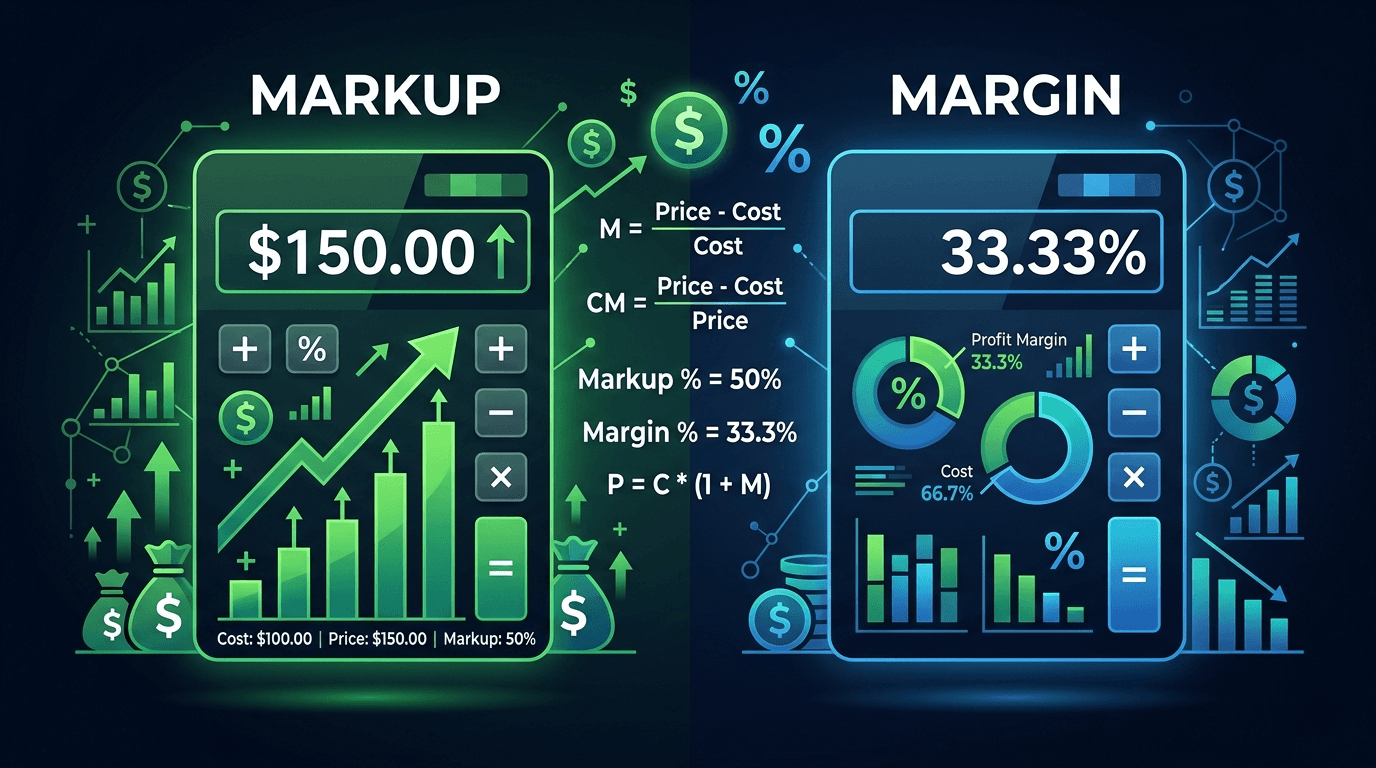
Example: You buy a product for $100 and sell it for $150.
- Markup = ($50 / $100) × 100 = 50% markup
- Margin = ($50 / $150) × 100 = 33.3% margin
A 50% markup does NOT equal a 50% margin. This is the number one mistake that costs businesses money — confusing these two metrics leads to underpricing and lost profit.
How to Calculate Markup (Step by Step)
Formula: Markup % = ((Selling Price - Cost) / Cost) × 100
Step 1: Subtract the cost from the selling price to get the gross profit.
Step 2: Divide the gross profit by the cost.
Step 3: Multiply by 100 to get the percentage.
Worked Example:
- Cost: $80
- Selling Price: $120
- Gross Profit: $120 - $80 = $40
- Markup: ($40 / $80) × 100 = 50%
To calculate selling price FROM markup: Selling Price = Cost × (1 + Markup% / 100)
- Cost: $80, Markup: 50%
- Selling Price = $80 × 1.50 = $120
How to Calculate Margin (Step by Step)
Formula: Margin % = ((Selling Price - Cost) / Selling Price) × 100
Step 1: Subtract the cost from the selling price to get the gross profit.
Step 2: Divide the gross profit by the selling price.
Step 3: Multiply by 100 to get the percentage.
Worked Example:
- Cost: $80
- Selling Price: $120
- Gross Profit: $120 - $80 = $40
- Margin: ($40 / $120) × 100 = 33.3%
To calculate cost FROM margin: Cost = Selling Price × (1 - Margin% / 100)
- Selling Price: $120, Margin: 33.3%
- Cost = $120 × 0.667 = $80
Why 50% Markup Does NOT Equal 50% Margin
This is the most common and costly mistake in pricing. Let's prove it with numbers:
50% Markup: Cost $100, add 50% = sell for $150. Profit = $50.
- Margin = $50 / $150 = 33.3% (not 50%!)
50% Margin: Selling price $150, margin is 50% = profit is $75.
- Cost = $150 - $75 = $75
- Markup = $75 / $75 = 100% (you need 100% markup to achieve 50% margin)
If you think you're making a 50% margin but you're actually applying a 50% markup, you're earning 33.3% margin — losing 16.7 percentage points of profit on every sale.
Markup to Margin Conversion Table
| Markup % | Margin % | Example (on $100 cost) |
|---|---|---|
| 10% | 9.09% | Sell for $110, profit $10 |
| 15% | 13.04% | Sell for $115, profit $15 |
| 20% | 16.67% | Sell for $120, profit $20 |
| 25% | 20.00% | Sell for $125, profit $25 |
| 30% | 23.08% | Sell for $130, profit $30 |
| 33.3% | 25.00% | Sell for $133, profit $33 |
| 40% | 28.57% | Sell for $140, profit $40 |
| 50% | 33.33% | Sell for $150, profit $50 |
| 75% | 42.86% | Sell for $175, profit $75 |
| 100% | 50.00% | Sell for $200, profit $100 |
| 150% | 60.00% | Sell for $250, profit $150 |
| 200% | 66.67% | Sell for $300, profit $200 |
Conversion formulas:
- Margin = Markup / (1 + Markup)
- Markup = Margin / (1 - Margin)
Common Markup Percentages by Industry
Markup varies dramatically by industry:
- Grocery/Supermarkets: 5-25% markup
- Retail Clothing: 100-300% markup
- Restaurants/Food Service: 100-300% markup
- Electronics: 25-50% markup
- Jewelry: 100-300% markup
- Furniture: 200-400% markup
- Auto Parts: 50-100% markup
- Software/SaaS: 500-1000%+ markup
- Construction: 10-20% markup
- Pharmaceuticals: 200-5000% markup
Higher markups are typical in industries with high perceived value, branding, or significant non-COGS costs. Lower markups are common in high-volume, commodity businesses.
When to Use Markup vs Margin
Use markup when:
- Setting retail prices from wholesale cost
- Calculating selling prices for new products
- Communicating pricing strategy to sales teams
- Working in procurement or purchasing
Use margin when:
- Analyzing financial statements and profitability
- Reporting to investors or stakeholders
- Comparing profitability across products or periods
- Making strategic business decisions about product mix
Most accounting software and financial reports use margin. Most day-to-day pricing uses markup. Understanding both — and knowing how to convert between them — is essential.
Common Mistakes That Cost Businesses Money
Mistake 1: Treating markup and margin as the same. A business owner who thinks a 30% markup gives a 30% margin is actually earning only 23.1% margin. Over thousands of transactions, this adds up to significant lost profit.
Mistake 2: Not accounting for all costs. Markup should cover not just COGS but also overhead, shipping, returns, and desired profit. Setting markup based only on product cost leads to underpricing.
Mistake 3: Using inconsistent metrics. If your sales team uses markup but your finance team reports margin, misalignment is inevitable. Standardize on one metric or ensure everyone can convert between them.
Mistake 4: Ignoring competitor pricing. A mathematically correct markup means nothing if it prices you out of the market. Markup should be a starting point, not the final answer.
Calculate markup and margin instantly with our free Markup Calculator — 100% client-side, no signup required.
Calculate markup, margin, and profit instantly with our free Math Tools — 100% client-side, no signup required. Try our 42+ free tools.