What actually shipped on July 31
DeepSeek V4 Flash 0731 is the generally available build of DeepSeek's cheap tier, released on July 31, 2026. The headline is not a bigger model. It is the same 284B-parameter CSA+HCA backbone and the same pricing as the April 2026 V4 Flash, re-post-trained for agentic work — and the result outscores DeepSeek's own V4 Pro on the Artificial Analysis Intelligence Index by 6 points.
That framing matters, because it is the interesting part. Nothing here came from scaling up. Every gain came from post-training the identical architecture to plan better, call tools more reliably, and survive multi-step workflows. Weights are on Hugging Face under the MIT license — unrestricted commercial use and modification — so the claims below are independently checkable rather than vendor-asserted.
The video above from WorldofAI put the model through a set of front-end and Three.js generation tasks the day it landed. We have used his hands-on findings where they are observational, verified every number against primary sources, and flagged one pricing figure that circulated incorrectly.
The benchmark numbers, and who reported them
These are DeepSeek's own published agent benchmarks for the 0731 build, with the two earlier checkpoints for context:
| Benchmark | Flash Preview | V4-Pro-Preview | Flash 0731 |
|---|---|---|---|
| Terminal Bench 2.1 | 61.8 | 72.1 | 82.7 |
| DeepSWE | 7.3 | — | 54.4 |
| Cybergym | — | — | 76.7 |
| NL2Repo | — | — | 54.2 |
| Toolathlon (verified) | — | — | 70.3 |
| Agents' Last Exam | — | — | 25.2 |
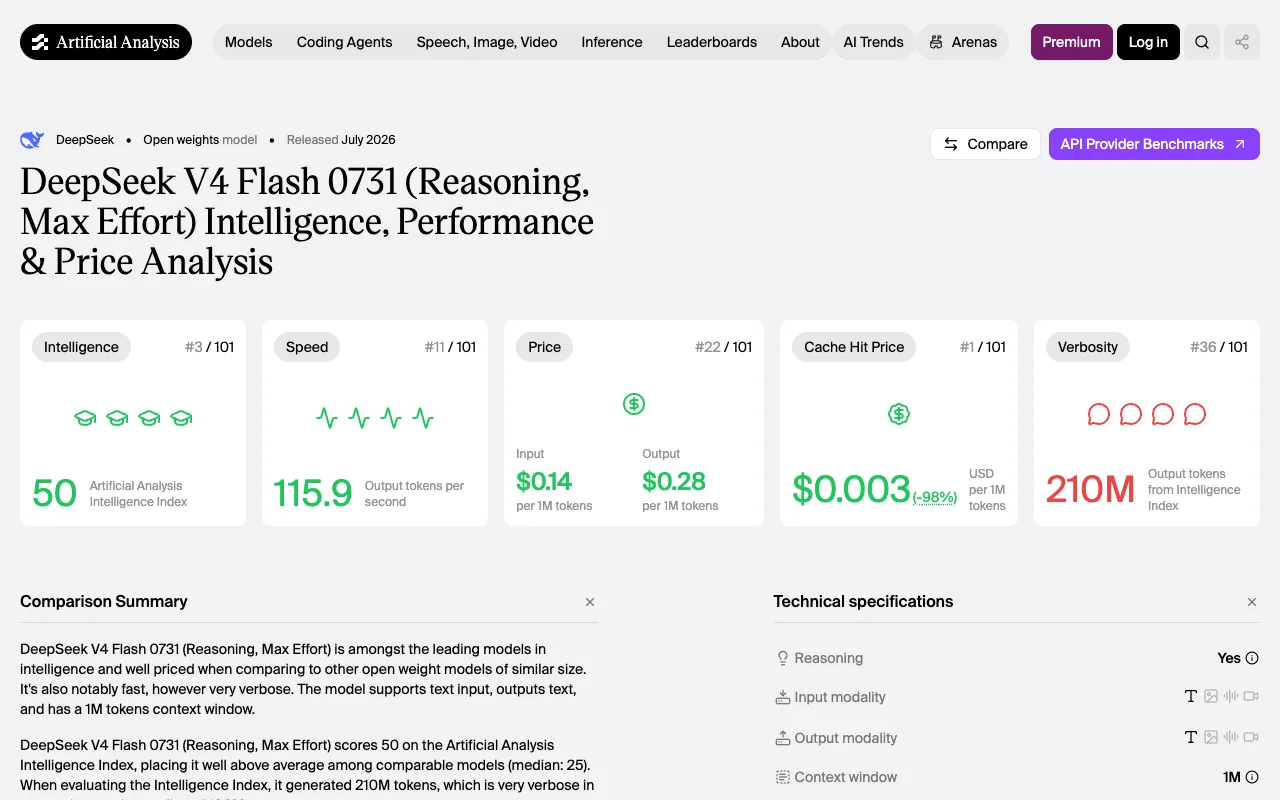
Independently, Artificial Analysis scores it 50 on the Intelligence Index — a 10-point jump over the April Flash, ranking #3 of 101 models tested and placing it among the top three open-weights models on the leaderboard. It also lands on their Pareto frontier for intelligence versus cost per task.
One caveat on sourcing. A separate "ranks 10th overall, beats Opus 4.7 and Sonnet 5" figure has circulated from the WorldofAI benchmark platform. That is his own evaluation harness with its own cost-weighting, not a third-party leaderboard, and it is not comparable to the Artificial Analysis number. Treat vendor benchmarks and creator benchmarks as what they are.
The DeepSWE jump is the real story
Terminal Bench going from 61.8 to 82.7 is a strong result. DeepSWE going from 7.3 to 54.4 is a different category of event — a 645% improvement on the same model size, from re-post-training alone.
A 7.3 means the preview build essentially could not do the task. A 54.4 means it completes more than half. That is not a model getting incrementally sharper; that is a capability switching on. And because the architecture and parameter count did not change, the entire delta is attributable to training method rather than compute.
This is the same lesson we drew from Needle's 26M-parameter tool-calling model: on agentic tasks specifically, how a model was trained to use tools is now outrunning how large it is. If you have been sizing your model choice by parameter count, that heuristic is expiring.
Pricing — the number most coverage gets wrong
A lot of the coverage, including the video above, quotes DeepSeek V4 Flash as "28 cents per million tokens." That is the output price only. The actual card:
| Price per 1M tokens | |
|---|---|
| Input (cache miss) | $0.14 |
| Input (cache hit) | $0.003 |
| Output | $0.28 |
The cache-hit rate is the line worth staring at. Artificial Analysis ranks it #1 of 101 models on cache-hit price. At $0.003 per million tokens, re-sending a long system prompt, a large document, or a fat few-shot block costs approximately nothing.
That is disproportionately valuable for agent loops, which re-read the same context on every turn. A coding agent that reloads a 50k-token repository map across 40 turns is billing almost entirely cache hits. This is the mechanism behind the cost claims — not the headline output price.
Pricing is unchanged from the April release, which means the intelligence gain came free to existing users. Context window is 1M tokens, and throughput measures 115.9 output tokens/sec.
How it compares to Opus 4.8, GLM 5.2, and Kimi K3
Being honest about the ceiling matters more than the excitement:
- Versus GLM 5.2 — V4 Flash 0731 wins on all eight benchmarks where GLM 5.2 has a published score. A clean sweep. Our GLM 5.1 coding-agent writeup covers where that family still holds an edge on integration.
- Versus Claude Opus 4.8 — it loses nine times out of nine, by an average of 5.7 points. But the margins are tight where it counts: Terminal Bench 82.7 against 85.0, Agents' Last Exam 25.2 against 25.7. Roughly Opus-adjacent output at a small fraction of the blended token cost. See our Opus 4.7 guide for what the frontier tier still buys you.
- Versus Kimi K3 — K3 still sets the open-weights frontier at 57 on the Intelligence Index, 7 points clear, with roughly 10× the parameters. Our Kimi K2.6 deep dive traces that lineage.
- Versus GPT-5.6 Luna — one single Intelligence Index point behind (51), even after OpenAI's price cut.
The pattern: it is not the best open-weights model, and it is not close to the closed frontier on raw capability. It is the best intelligence-per-dollar on the board right now, which for most agent workloads is the metric that determines whether the project is viable at all.
Running it yourself: weights, size, and hosts
The weights went public on release day, MIT-licensed, at 166.9 GB:
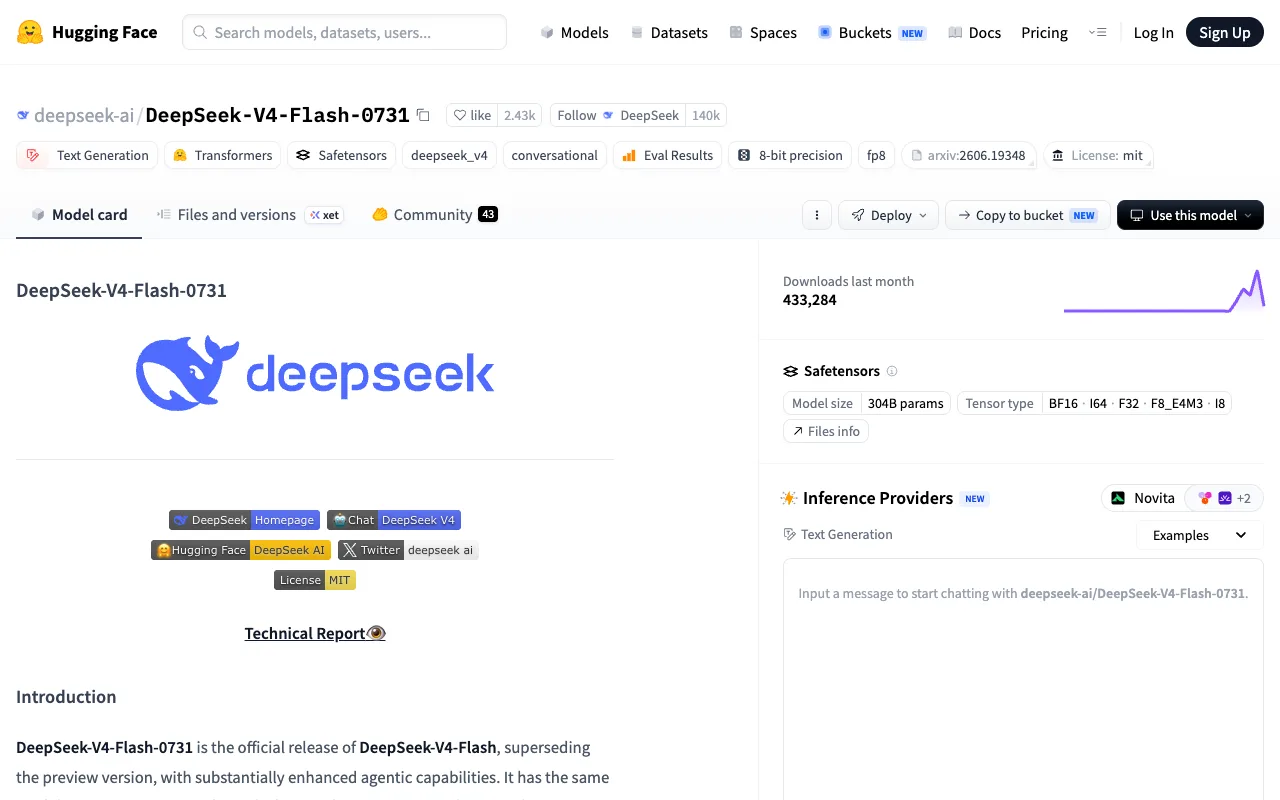
166.9 GB is the number to plan around, and it rules out consumer hardware for the full-precision checkpoint. Quantized GGUF builds are what most people will actually run locally — worth noting because deepseek-v4-flash gguf is already a searched term, which tells you where demand is.
For local use, Ollama carries it:
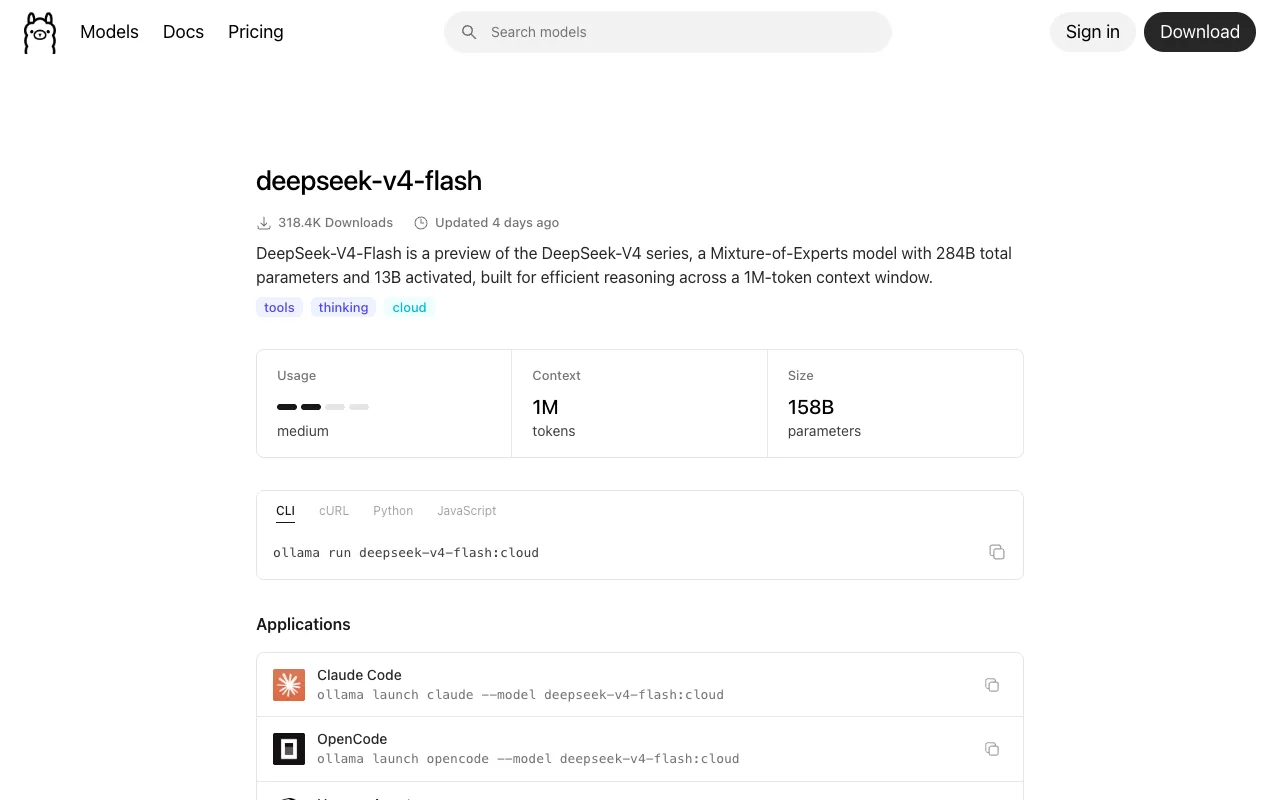
Hosted access is broad: OpenRouter, Fireworks, DeepInfra, and LM Studio all list it. One practical limitation from the video that we confirmed against DeepSeek's own surfaces — it is API-first and not yet exposed in the DeepSeek web or mobile app, so you cannot try it by logging into the consumer chat.
If you want it driving an agent rather than answering one-off prompts, point a harness at it. Our Codex + Ollama guide walks the exact config, and the wire_api = "responses" warning in there will save you an afternoon.
The catch nobody puts in the headline
Two honest limitations.
First-output quality does not hold across iterations. The most useful observation in the WorldofAI testing was that first generations are frequently excellent while follow-up refinements degrade — becoming incomplete or stranger than the opening attempt. If your workflow is iterative refinement rather than one-shot generation, that unreliability matters more than any benchmark line. This is a hands-on observation rather than a measured result, so treat it as a lead to test on your own workload, not a settled fact.
It is extremely verbose. Artificial Analysis measured 210M tokens generated across the Intelligence Index run, ranking it #36 of 101 on verbosity — meaning it talks a lot. On a per-token price this cheap that is mostly survivable, but verbosity inflates latency and chews context window, and it partially offsets the headline cost advantage on output-heavy tasks.
Where it is genuinely strong, per the hands-on testing: front-end generation, Three.js and 3D scene work, and debugging. Where it is weaker: sustained multi-turn refinement, and anything needing the last few points of raw capability.
Verdict, and sources
Reach for DeepSeek V4 Flash 0731 when cost per task is the binding constraint on whether your agent workload ships at all, when your loop re-reads large context (the $0.003 cache hit is the whole argument), or when you need MIT-licensed open weights you can self-host and modify commercially.
Reach past it when you need the top few points of capability — Opus 4.8 wins 9/9 for a reason — or when your workflow depends on many refinement turns rather than strong first outputs.
The broader read: a 284B model matched its own flagship through post-training alone, then gave the gain away at unchanged prices. As we argued when Anthropic began metering the Agent SDK, the economics of running agents continuously are what will decide which models people actually deploy, and this release moves that line.
Sources
- Artificial Analysis — DeepSeek V4 Flash 0731 analysis — Intelligence Index 50, #3/101, pricing, speed, verbosity
- Artificial Analysis — 10-point jump writeup
- Hugging Face — deepseek-ai/DeepSeek-V4-Flash-0731 — MIT license, 166.9 GB weights
- DeepSeek — V4 Flash GA agent benchmarks — vendor-published benchmark table
- DeepSeek API pricing — $0.14 / $0.003 / $0.28 per 1M tokens
- Ollama — deepseek-v4-flash — local runtime
- WorldofAI — DeepSeek V4 Flash GA hands-on — generation testing and the iteration-degradation observation
Benchmark figures are as published on August 5, 2026. Vendor-reported numbers are labelled as such throughout; verify against your own workload before committing.