What Meta actually shipped on August 5
Meta Superintelligence Labs released Muse Spark 1.2 on August 5, 2026, and paired it with something more interesting than another model card: Muse Code, a terminal coding agent in beta for macOS and Linux, installed by curl script and driven by the new model.
This is Meta's third model release in four months — Muse Spark 1.0 in April, 1.1, now 1.2 — and the cadence is the story as much as the scores. A year ago Meta was widely written off in the frontier race. On Artificial Analysis's numbers they are now tied for third place among US labs.
The pitch is aggressive pricing against frontier-adjacent capability, plus a second pricing tier that is cheap enough to raise an eyebrow. Both halves need unpacking, and one widely repeated number about that cheap tier is being quoted without the qualifier that makes it true.
Everything below is sourced from Meta's own release post, Artificial Analysis's independent evaluation, and the live provider listing. Where a figure is vendor-reported rather than third-party measured, it says so.
The benchmarks, and who measured them
Two different bodies measured this model, and conflating them is how bad takes get written.
Meta's own agent benchmarks (model + Muse Code harness, versus rival model + rival harness):
| Benchmark | Muse Spark 1.2 + Muse Code | Best rival | Also |
|---|---|---|---|
| Terminal-Bench 2.1 | 82.9% | Opus 5 + Claude Code — 86.7% | GPT-5.6 Terra + Codex 81.8%, Grok Build 81.6% |
| DeepSWE 1.1 | 59.3% | Opus 5 — 65.0% | Codex 64.8% |
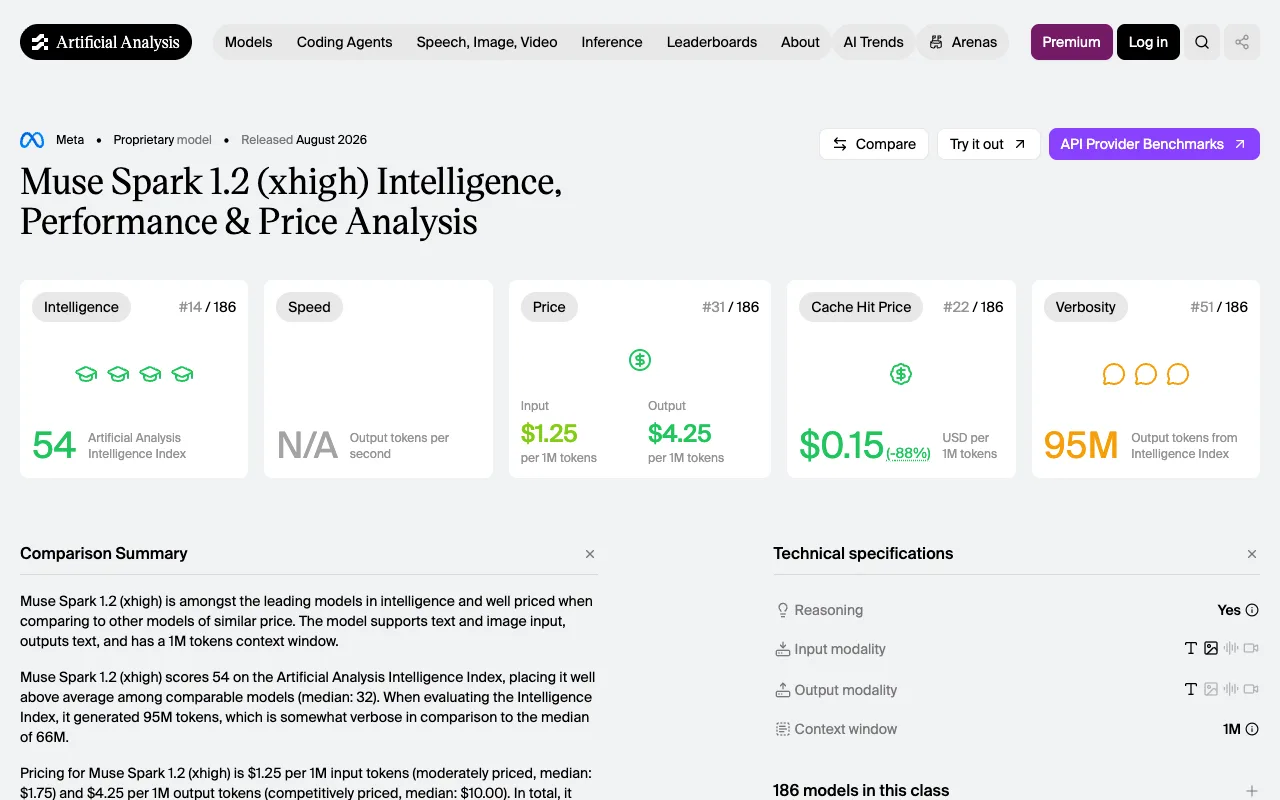
Artificial Analysis, independent — Muse Spark 1.2 (xhigh) scores 54 on the Intelligence Index, ranking #14 of 186 models in its class, and 1631 Elo on GDPval-AA v2, which is 5th place overall. That is the panel at the top of this post.
Read the two tables together and the picture is consistent: Muse Spark 1.2 beats the mid-tier and loses to the frontier, by a modest and shrinking margin. On Terminal-Bench it edges out both Codex and Grok Build while trailing Claude Code on Opus 5 by 3.8 points. On GDPval it sits behind Opus 5 (1852), GPT-5.6 Sol (1730), and Kimi K3 (1685) — but ahead of Claude Opus 4.8 (1588), which is a real scalp.
One correction worth making, because it is circulating: Muse Spark 1.2 does not surpass Grok 4.5. Artificial Analysis has them tied at 54, with GPT-5.5 (xhigh) a point ahead at 55.
The generational curve is the actual signal
A single release tells you less than the slope. Meta's Intelligence Index trajectory across four months:
| Release | Intelligence Index | GDPval-AA v2 Elo |
|---|---|---|
| Muse Spark 1.0 (April) | 43 | — |
| Muse Spark 1.1 | 51 | 1371 |
| Muse Spark 1.2 | 54 | 1631 |
Eleven index points in four months. And the gain is not spread evenly — Artificial Analysis notes the 3-point jump from 1.1 to 1.2 is concentrated in agentic evaluations, with GDPval-AA v2 alone moving +260 Elo. Meta's own framing matches: they say they "significantly scaled up training compute on coding tasks while expanding training environment diversity."
Against the harness benchmarks, 1.2 improves on 1.1 by 6.7 points on Terminal-Bench and 6.3 on DeepSWE.
This is the same pattern we flagged in DeepSeek's V4 Flash 0731 release a week ago: the interesting movement in mid-2026 is coming from agentic post-training and environment design, not from parameter scaling. Two labs, different continents, same lever.
Pricing — and decoding the "250x cheaper" claim
Muse Spark 1.2 ships with two tiers, and the gap between them is the most aggressive thing about this launch:
| Standard | Contributor | |
|---|---|---|
| Input / 1M | $1.25 | $0.10 |
| Cached input / 1M | $0.15 | $0.002 |
| Output / 1M | $4.25 | $0.20 |
The contributor tier is roughly 12× cheaper on input and 21× cheaper on output than standard. The trade is explicit: you opt in to letting Meta use your data — prompts, uploaded documents, repositories — to improve their models.
Now the claim doing the rounds. You will see "250× cheaper than Claude Fable 5" quoted flatly. Here is the arithmetic behind it. Fable 5 runs about $10 per 1M input and $50 per 1M output. So:
- Contributor output vs Fable 5 output: $50 ÷ $0.20 = 250×. True.
- Contributor input vs Fable 5 input: $10 ÷ $0.10 = 100×.
- Standard tier vs Fable 5: roughly 8× cheaper input, 12× cheaper output.
So "250× cheaper" is real but it is the single most flattering cell in the table — output tokens, on the data-sharing tier. If you are on standard pricing and your workload is input-heavy, your actual saving against Fable 5 is closer to 8×. Still substantial. Not 250.
The contributor tier's real cost is not privacy
The data-sharing trade-off gets all the attention. The rate limits get almost none, and for anyone actually running an agent they are the bigger constraint:
| Standard | Contributor | |
|---|---|---|
| Requests / minute | 3,000 | 60 |
| Tokens / minute | 4,000,000 | 2,100,000 |
That is a 50× reduction in request throughput. Sixty requests per minute is one per second.
Think about what a terminal coding agent does. It reads files, runs a command, reads output, plans, edits, re-runs tests — dozens of round trips for a single non-trivial task, and Muse Code explicitly coordinates multiple background subagents in parallel. On the contributor tier those subagents are contending for one request per second between them.
So the honest framing of the cheap tier is not "20× cheaper if you don't mind Meta training on your code." It is "20× cheaper if you don't mind Meta training on your code and you can live inside 60 requests per minute." For a solo developer on one repo, that may genuinely be fine. For a team, or for parallel agent fan-out, the standard tier is not optional — which puts you back at $1.25/$4.25, where the comparison against rivals is competitive rather than absurd.
Price the tier you will actually be allowed to run.
Muse Code: what the agent does differently
The model is only half the release. Muse Code is Meta's answer to Claude Code and Codex, and two design choices stand out.
Persistent async background subagents. Muse Code plans changes, writes code, validates results, and coordinates multiple long-lived subagents working in parallel across a large repository. Parallel subagents are becoming table stakes; making them persistent rather than per-invocation is the differentiator Meta is pushing.
A replay-exact event log. Every action is journaled such that a crash resumes exactly where it stopped. Anyone who has lost forty minutes of agent progress to a dropped connection will recognise why this matters more than another benchmark point. It is the least glamorous feature in the release and probably the most practically useful.
Availability: beta, macOS and Linux only, installed via curl script, plus access through the Meta Model API. No Windows at launch.
If you are weighing harnesses rather than models, our Codex + Ollama guide covers the configuration tax of running an agent against a swappable backend — a flexibility Muse Code does not offer, since it is co-trained with Muse Spark and points at Meta's API.
The multimodal input nobody is leading with
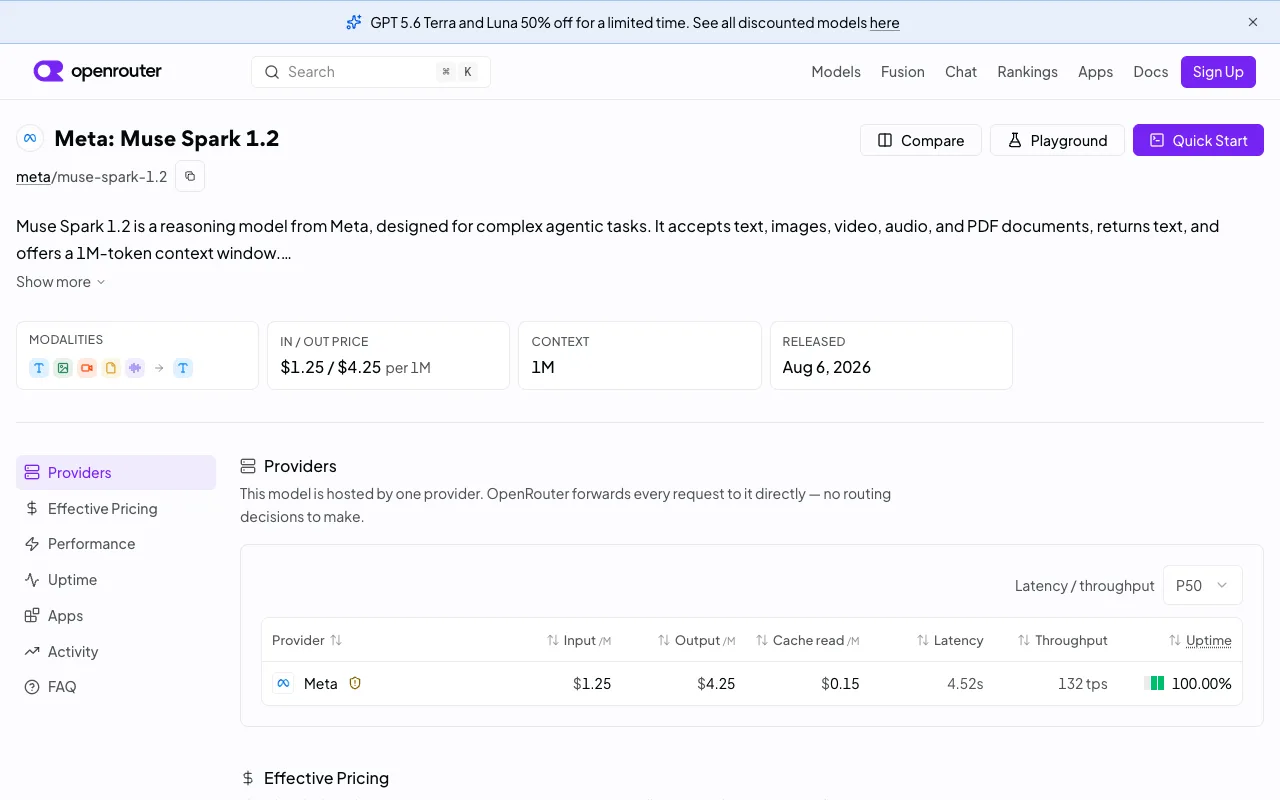
Buried in the provider listing is the most differentiated capability in this release. Muse Spark 1.2 accepts text, images, video, audio, and PDF documents, and returns text, across a 1M-token context window.
Video and audio as first-class inputs to a coding model is unusual. Most agents that claim multimodality mean screenshots. Being able to hand a walkthrough recording or a recorded design review directly to the agent that will write the code is a different workflow, and it is the capability Meta seems least interested in marketing.
Measured performance on the live endpoint: 132 tokens/sec throughput at 4.52s latency, single provider (Meta direct), 100% uptime at time of writing.
One caveat from the Artificial Analysis panel above — verbosity measures 95M tokens generated across the Intelligence Index run, against a 66M median for comparable models, ranking #51 of 186. It is somewhat verbose. On a $4.25 output rate that is a real line item, and it eats the 1M context faster than the number suggests.
Worth noting for anyone searching this: Muse Spark 1.2 is a proprietary model. It is not open weights, there is no Hugging Face download, and you cannot self-host it. That is a meaningful contrast with DeepSeek's MIT-licensed V4 Flash and with Kimi K2.6, and it is the single most common misconception about the Muse Spark line given Meta's Llama history.
Verdict, and sources
Reach for Muse Spark 1.2 when you want frontier-adjacent agentic coding at mid-tier pricing, when your workflow can feed it video, audio, or PDFs alongside code, or when you are a solo developer who can genuinely live inside the contributor tier's 60 req/min ceiling and does not mind the data trade.
Reach past it when you need the top of the board — Opus 5 leads Terminal-Bench by 3.8 points and GDPval by 221 Elo — when you need open weights you can self-host, or when parallel agent fan-out makes the contributor rate limit unworkable and the standard tier's price advantage narrows to ordinary.
The broader read: Meta went from written-off to tied-for-third among US labs in four months, and did it by buying agentic capability with post-training compute rather than parameters. Combined with DeepSeek's near-identical playbook last week, the mid-2026 pattern is clear — the frontier is pulling away slowly while the tier beneath it gets dramatically cheaper. For most teams that second trend matters more.
Sources
- Meta AI Research — Introducing Muse Code and Muse Spark 1.2 — official announcement, August 5, 2026
- Artificial Analysis — Muse Spark 1.2 analysis — Intelligence Index 54, #14/186, pricing, verbosity, proprietary status
- Artificial Analysis — Muse Spark 1.2 writeup — generational deltas, GDPval-AA v2 Elo, lab standings
- OpenRouter — Meta Muse Spark 1.2 — live pricing, modalities, throughput and latency
- VentureBeat — Meta enters the AI coding wars — persistent background agents, tier rate limits
- The Register — Meta wants to get inside your terminal — harness benchmark comparisons
Figures as published on August 6, 2026. Meta's harness benchmarks are vendor-reported and labelled as such; Artificial Analysis figures are independent. We have not run this model against a production workload — benchmark it on your own tasks before migrating anything.