What Z.ai actually shipped
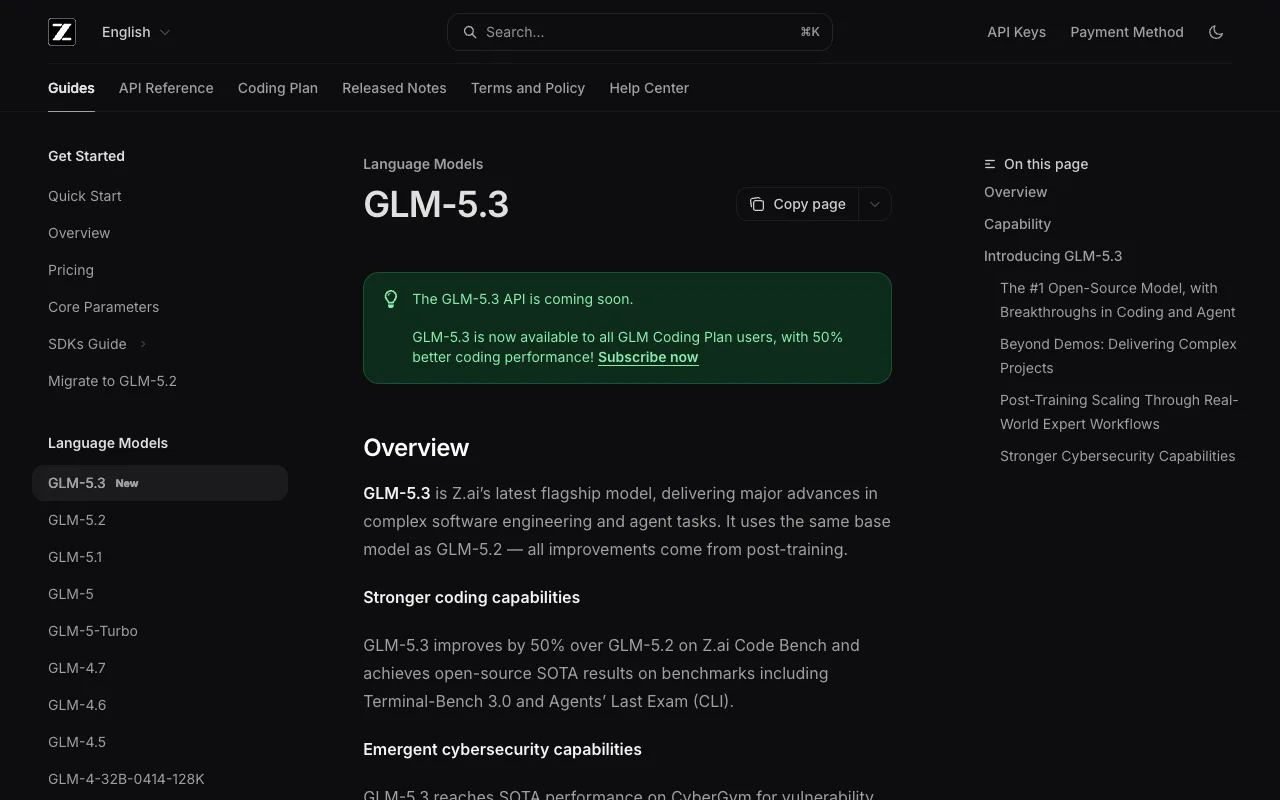
Z.ai released GLM-5.3 on August 14, 2026, and the interesting part is what they didn't do: there is no new architecture and no bigger model. GLM-5.3 runs on the same 743-billion-parameter base as GLM-5.2, and every capability gain comes from scaled-up post-training.
Z.ai's own documentation is blunt about it: "It uses the same base model as GLM-5.2 — all improvements come from post-training."
Three things you need to know before reading any coverage of this launch:
- The weights are not public yet. Z.ai says roughly two weeks, pending safety evaluation and hardening.
- There is no standard API price. The docs say the GLM-5.3 API is "coming soon". Figures circulating for it are GLM-5.2's rates, not GLM-5.3's.
- Access today is through the GLM Coding Plan only.
The headline result is not the coding score. It is cybersecurity, and it is the first time an open-weight model has taken the top spot on that benchmark.
The benchmark gains
Z.ai's published numbers, GLM-5.2 → GLM-5.3:
| Benchmark | GLM-5.2 | GLM-5.3 | Change |
|---|---|---|---|
| Terminal-Bench 3.0 | 4.6 | 28.3 | +515% |
| DeepSWE v1.1 | 46.2 | 66.9 | +45% |
| Agents' Last Exam (CLI) | 23.8 | 28.5 | +20% |
| Z.ai Code Bench | — | +50% vs 5.2 | vendor-measured |
Terminal-Bench 3.0 going from 4.6 to 28.3 is the number that should catch your eye. A 4.6 means the previous model essentially could not do the task at all. Getting to 28.3 without touching the base model is a capability appearing from training method alone.
Z.ai claims open-source SOTA on Terminal-Bench 3.0 and Agents' Last Exam (CLI). These are vendor-published benchmarks — treat them as claims until third-party evaluations land, which they will once the weights ship.
We saw the identical pattern with DeepSeek's V4 Flash 0731, where DeepSWE jumped from 7.3 to 54.4 on an unchanged architecture. Two labs, same lever: in mid-2026 the returns are coming from post-training and environment design, not parameter count.
The cybersecurity result is the actual story
On CyberGym — a benchmark that tests whether a model can find and validate real vulnerabilities from white-box source code — GLM-5.3 scores 84.5, ahead of both closed frontier models:
| Model | CyberGym | Type |
|---|---|---|
| GLM-5.3 | 84.5 | Open weights (pending) |
| Claude Mythos 5 | 83.8 | Closed |
| GPT-5.6 Sol | 83.6 | Closed |
An open-weight model holding state of the art on a security benchmark is a genuinely new situation, and it is not a demo-only result. Z.ai reports that since GLM-5.2, its models have identified 2,436 vulnerabilities across 269 open-source projects, of which 1,097 were rated critical or high severity.
Note the precise framing there — that figure covers the model family since 5.2, not GLM-5.3 alone. Several write-ups have attributed the whole number to 5.3. It is still a striking result, but attribute it correctly.
Z.ai describes the capability as emergent — it outgrew what the training targeted. The model reasons through complete multi-step exploitation chains rather than just flagging suspicious code, which is the difference between a linter and an analyst.
Why the weights are delayed
Z.ai is holding the open weights for roughly two weeks after launch while it completes safety evaluation and hardening, and is rolling access out slowly rather than pushing to every provider at once. That is why you may not find GLM-5.3 on OpenRouter or similar gateways yet.
The reason is the section above. A model that autonomously chains multi-step exploits is dual-use by construction: the same capability that finds 1,097 critical vulnerabilities in open-source projects finds them in software you do not own. Once open weights ship, no safeguard survives — anyone can fine-tune the guardrails off.
Two honest observations:
This is a real constraint on the release, not marketing. A vendor that wanted maximum launch noise would ship the weights on day one.
It also does not solve anything permanently. A two-week delay hardens the released artifact; it does not change what the artifact can do once it is public. The security community gets a genuinely powerful auditing tool and everyone else gets the same thing. Worth watching how this precedent develops, because GLM-5.3 will not be the last open model to top a security benchmark.
Pricing — what is published, and what is not
Be careful here, because the widely quoted figures are wrong.
You will see GLM-5.3 reported at "$1.40 per 1M input, $4.40 per 1M output, unchanged from GLM-5.2". Z.ai's own pricing table does not list GLM-5.3 at all:
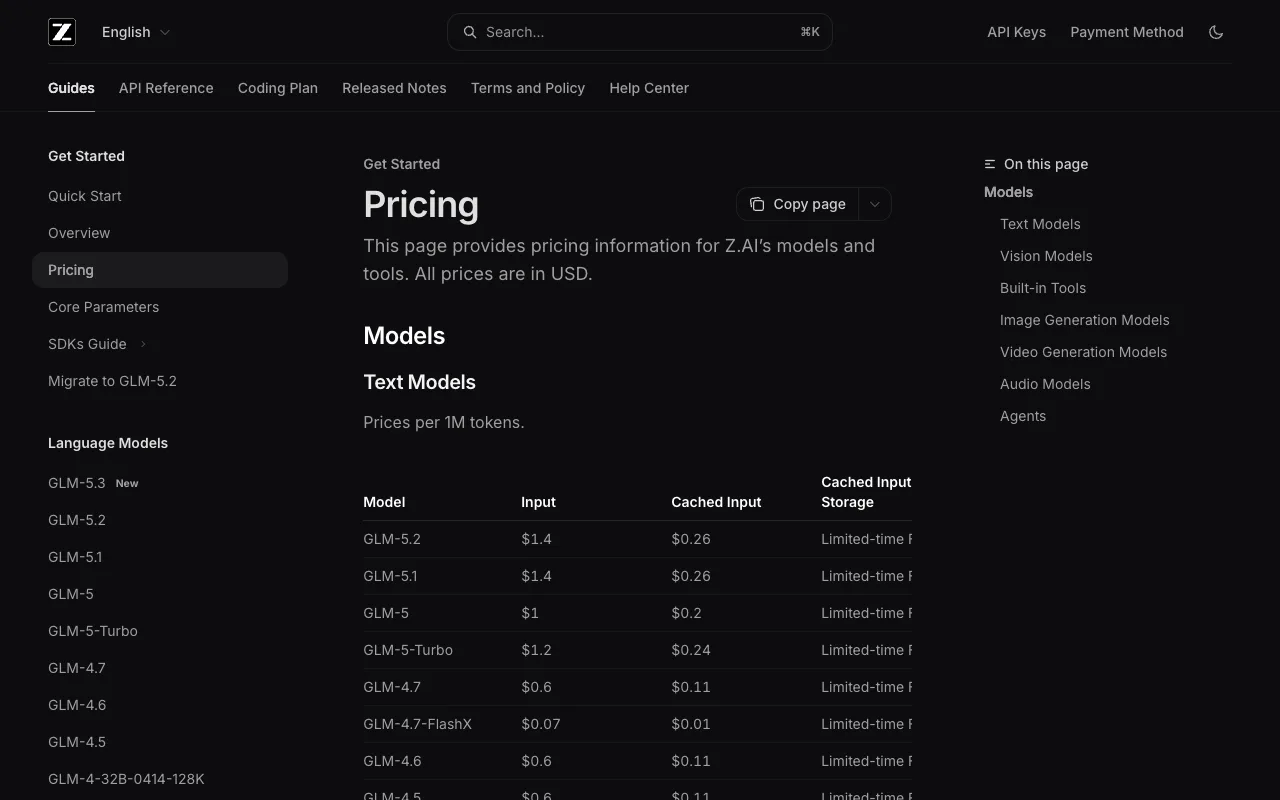
What the table actually shows, per 1M tokens:
| Model | Input | Cached input |
|---|---|---|
| GLM-5.2 | $1.40 | $0.26 |
| GLM-5.1 | $1.40 | $0.26 |
| GLM-5 | $1.00 | $0.20 |
| GLM-4.7 | $0.60 | $0.11 |
| GLM-5.3 | not listed | not listed |
The docs state the GLM-5.3 API is "coming soon". So the $1.40 figure is GLM-5.2's rate being assumed forward. It may well end up correct — Z.ai has held pricing flat across 5.1 and 5.2 — but nobody can currently cite it as GLM-5.3's price, and you should not budget against it.
If you have been following DeepSeek's price increase, the lesson applies here too: cheap open-model pricing is a strategic choice, not a law of nature, and it gets revisited when demand outruns capacity.
How to get access today
Until the API opens and the weights drop, there is one route: the GLM Coding Plan.
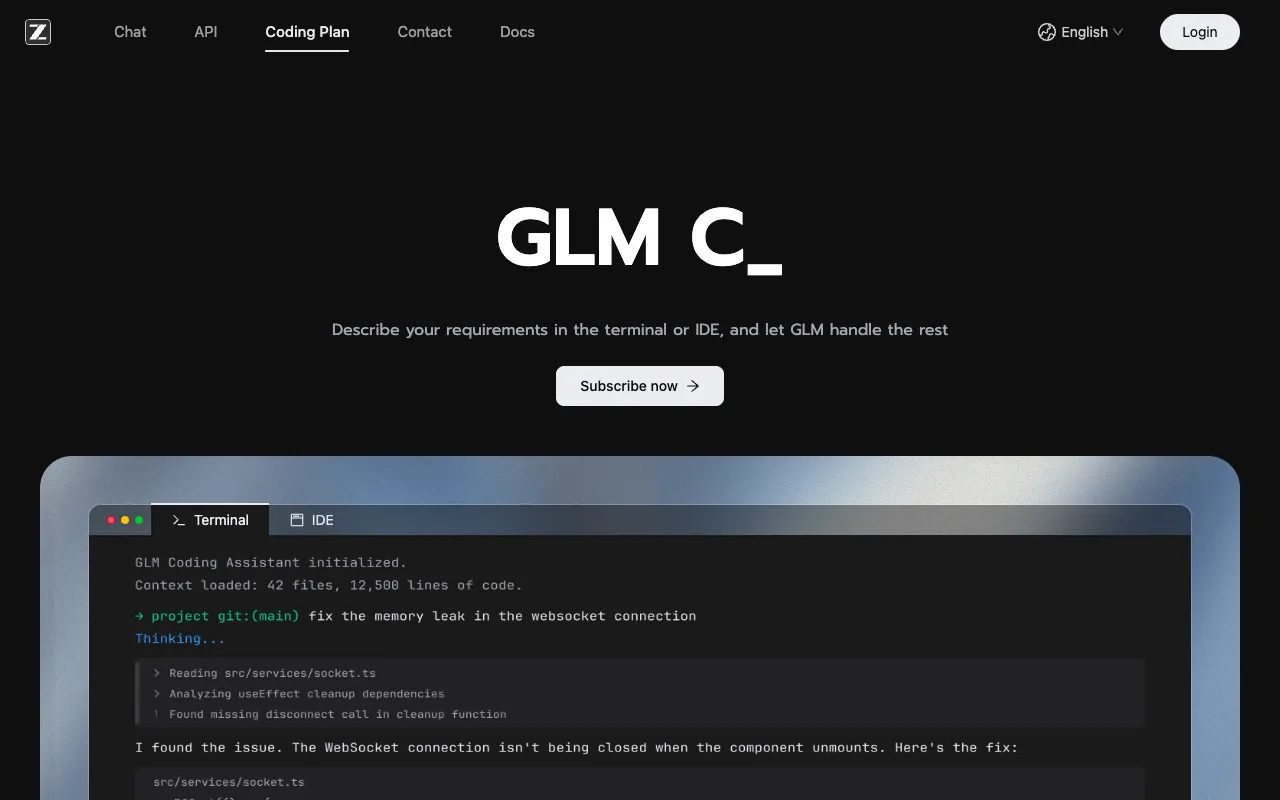
Z.ai's docs confirm GLM-5.3 is live for all Coding Plan subscribers, addressed as `glm-5.3[1m]` for the one-million-token context variant, with a 1M compaction window when driven through Claude Code.
Where it runs:
- Z.ai's own coding agent — the vendor's harness, and where the model is tuned to perform best
- Claude Code — pointed at Z.ai as the backend
- OpenCode and similar OpenAI-compatible harnesses
The Coding Plan also carries off-peak discounts and caching benefits, which matter more than headline rates for agent loops that re-read the same context repeatedly.
If you would rather not commit to a subscription for a model whose weights are two weeks out, waiting is reasonable. The open weights will run through Ollama and LM Studio once released, though at 743B parameters you will need serious hardware or a hosted provider regardless.
What GLM-5.3 is not
Three limitations that the launch coverage tends to skip.
It is not multimodal. No vision. GLM-5.3 handles text and code only, which rules it out for screenshot-to-code, diagram interpretation, and design-to-implementation work. Every closed frontier model it competes with on coding benchmarks accepts images. If your workflow needs that, this is disqualifying regardless of the scores.
It does not beat the closed frontier outright. It wins CyberGym and claims open-source SOTA on two coding benchmarks. It does not lead across the board against Claude Mythos 5 or GPT-5.6 Sol. The accurate framing is "an open-weight model competing seriously with proprietary giants on specific axes" — which is impressive on its own terms and does not need inflating.
You cannot self-host it yet. Until the weights ship, "open weights" is a promise rather than a property. Judge it as a hosted model today.
For context on where it sits among open models, our Kimi K2.6 deep dive covers the model that has held the open-weights crown, and our GLM-5.1 coding-agent writeup traces where this line started.
Verdict, and sources
GLM-5.3 matters for two reasons, and only one of them is the coding score.
The coding gains are real and the method is notable — a 515% jump on Terminal-Bench 3.0 from post-training alone, on an untouched 743B base. That is a genuine result and it continues the 2026 pattern of capability coming from training method rather than scale.
But the cybersecurity result is the one that will still matter in a year. An open-weight model taking state of the art on vulnerability discovery, ahead of both Claude Mythos 5 and GPT-5.6 Sol, with a two-week weight delay for safety hardening, is a preview of a much larger argument the industry has not settled.
Practical advice: if you are on the GLM Coding Plan already, use it — 50% better coding performance at no price change is straightforwardly good. If you are not, waiting two weeks for the weights and third-party benchmarks costs you nothing and gets you numbers that were not published by the vendor selling the model.
Sources
- Z.ai — GLM-5.3 documentation — architecture, post-training claims, API status, Coding Plan availability
- Z.ai — API pricing — the rate table showing GLM-5.3 is not yet priced
- Z.ai — GLM Coding Plan — the current access route
- Unite.AI — Z.ai launches GLM-5.3 — CyberGym comparison figures
- MarkTechPost — Z.ai ships GLM-5.3 without retraining the base model — benchmark deltas, weight-release timing
- heise online — GLM 5.3 improves security capabilities — vulnerability discovery figures
Accurate as of August 14, 2026. Benchmark figures are vendor-published; independent evaluations should follow once weights are released. No standard API price for GLM-5.3 had been published at the time of writing.