The short answer
Qwen3.8-27B is, right now, the strongest local LLM for coding that most people can actually run. Not the strongest open model in absolute terms — that title belongs to models you cannot fit on a consumer GPU — but the best combination of capability and hardware reality available today.
The specifics that matter:
- 27.78B dense parameters, natively multimodal, Apache 2.0 licensed
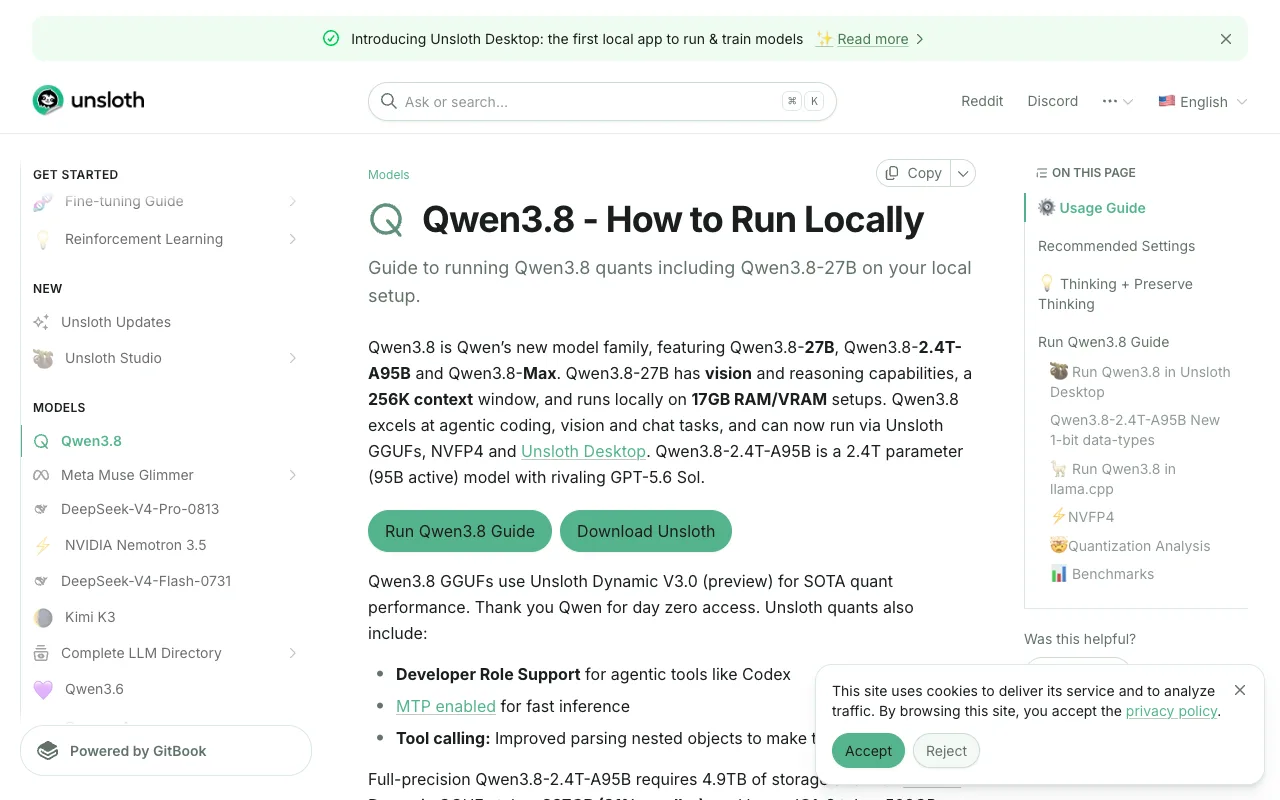
- Runs in ~17 GB as a 4-bit quant — fits a 24 GB card with room for context
- 262,144-token native context, extendable to 1M via YaRN
- Released August 14, 2026, weights on Hugging Face day one
The catch, and there is one: "runs locally" and "matches a frontier model" are two different claims, and only the first is verifiable. This guide covers what the benchmarks actually say, exactly what hardware you need, and where the enthusiasm outruns the evidence.
What Alibaba released
Two models, same generation, very different audiences.
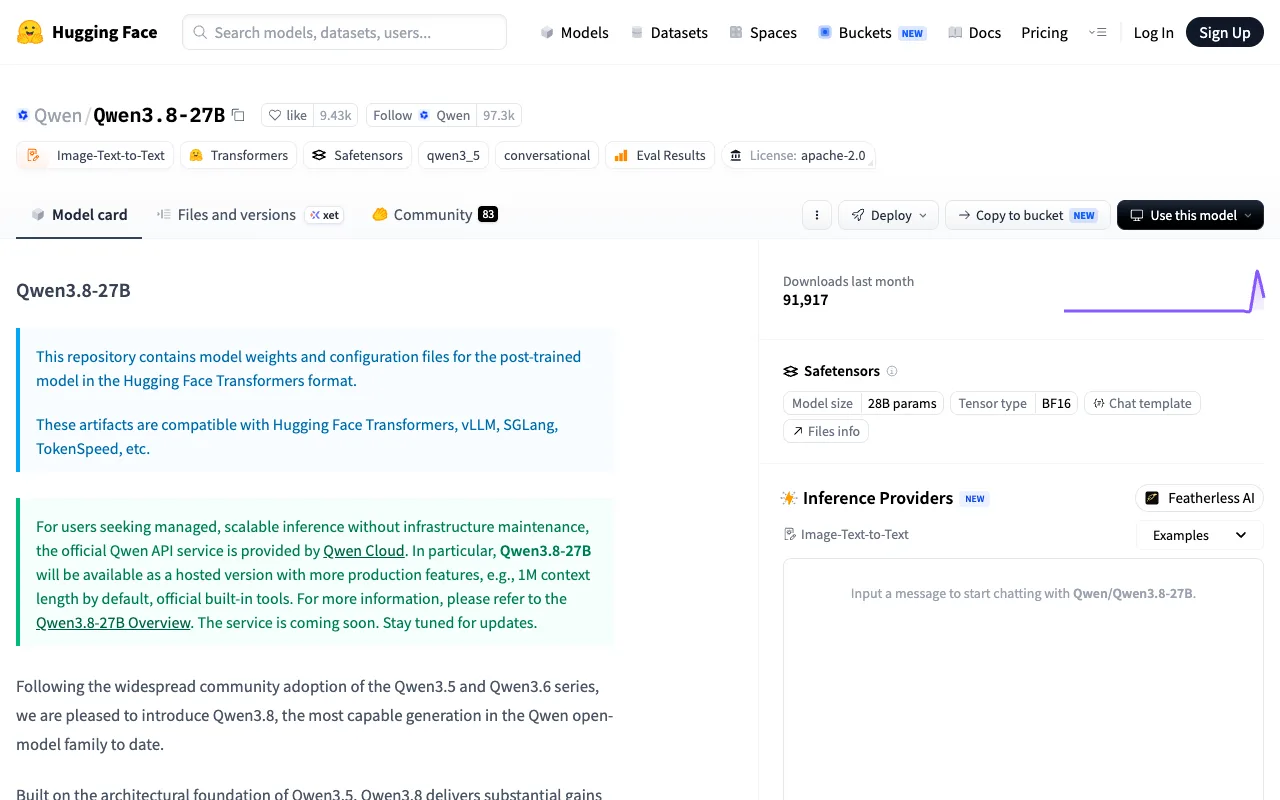
Qwen3.8-27B is the one that matters for local use. It is a dense 27.78-billion-parameter model — not a mixture-of-experts — which is precisely why it runs on consumer hardware. It is natively multimodal, tagged Image-Text-to-Text on Hugging Face, so it reasons over screenshots, charts, and UI mockups rather than text alone. Apache 2.0 means you can download it, run it, fine-tune it, and ship products on it with no licensing conversation.
Qwen3.8-2.4T-A95B is the Max-class sibling: 2.4 trillion parameters with 95B active, which Unsloth describes as rivalling GPT-5.6 Sol. Also open-weight. Also completely impractical locally — full-precision storage alone runs to 4.9 TB.
The dense-versus-MoE distinction is the whole story of why the 27B is interesting. A 27B dense model has predictable memory behaviour and quantizes cleanly. That is what makes a frontier-adjacent model fit on a gaming GPU.
Community uptake was immediate — 91,917 downloads in the first month on the Hugging Face repo alone.
The benchmarks, honestly
Qwen's published results for the 27B at release:
| Benchmark | Qwen3.8-27B |
|---|---|
| SWE-Bench Pro | 61.7% |
| QwenSWEBench | 79.0% |
| DeepSWE 1.1 | 42.2% |
Alibaba's headline claim is that the 27B outperforms Qwen3.7-Plus overall while being dramatically smaller, with particular strength in real-world coding, agentic workflows, and office tasks.
61.7% on SWE-Bench Pro from a 27B model is a genuinely strong result — this is a benchmark where models an order of magnitude larger were scoring lower not long ago.
Now the part worth being careful about. You will see this model described as "Opus-level locally" or "basically frontier performance for free". Treat that as enthusiasm, not measurement. The DeepSWE 1.1 score of 42.2% is the useful reality check: GLM 5.3 scores 66.9 on the same benchmark and DeepSeek V4 Flash scores 54.4. Both are far larger models you cannot run locally, and both are well ahead.
The accurate framing is: exceptional for 27B parameters, competitive with models several times its size, and not equivalent to the closed frontier. That is still a remarkable thing to have running on your own GPU for free.
Hardware — what you actually need
This is the section that decides whether the model is relevant to you.
| Setup | Feasible? | Notes |
|---|---|---|
| 24 GB VRAM (RTX 4090/3090) | ✅ Yes | 4-bit quant lands at 14–17 GB. The mainstream Q4_K_M is 16.8 GB. Comfortable. |
| 32 GB VRAM/RAM | ✅ Comfortable | Room for longer context without renegotiating settings |
| 48–64 GB | ✅ Ideal | Higher quants, full context, no compromises |
| 16 GB | ⚠️ Tight | Smaller quants only, quality drops noticeably |
| Apple Silicon, 24 GB+ unified | ✅ Yes | 4-bit GGUF works well through llama.cpp, LM Studio or Ollama |
| Under 16 GB | ❌ Painful | Spilling into system RAM drops throughput to a few tokens/sec |
Two things people forget:
Budget for KV cache. Add 1–3 GB on top of the weights at everyday context lengths, and it scales with context. A model that fits at 4K context may not fit at 128K.
NVFP4 beats GGUF on Blackwell. If you have a 50-series card, the NVFP4 build is substantially faster than an ordinary GGUF quant. On older hardware the GGUF is the practical download.
If you are shopping for hardware specifically: 24 GB VRAM is the threshold that makes this model comfortable, and that is the cheapest entry to genuinely capable local coding today.
How to run it
Three routes, in order of how little you need to know.
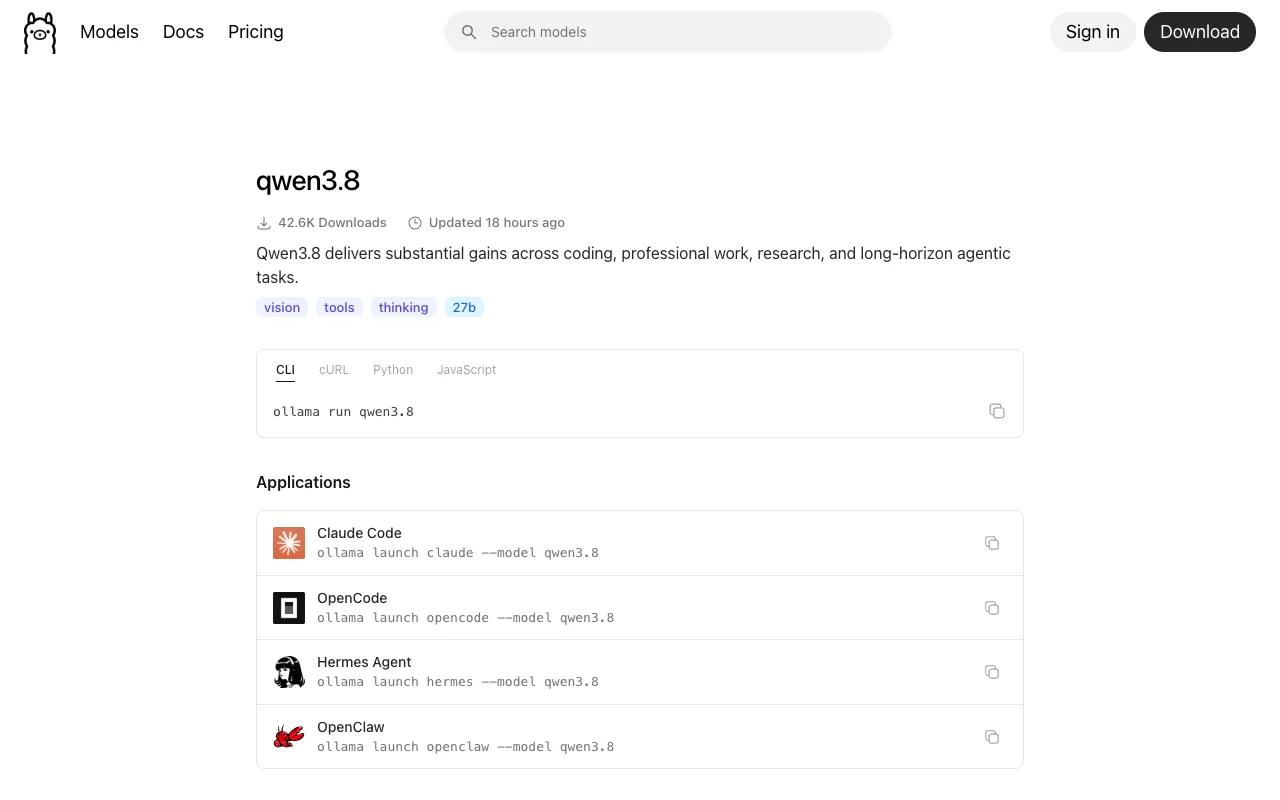
Ollama — the fastest path. One pull and it serves an OpenAI-compatible API on port 11434, so any tool that speaks that dialect can drive it.
LM Studio — best if you want to compare quants before committing. Its catalog shows which files fit your actual system memory, which saves the download-then-discover cycle. Our LM Studio vs Ollama comparison covers which fits your workflow — short version, LM Studio to pick the quant, Ollama to serve it.
llama.cpp or Unsloth — most control. Unsloth ships Dynamic V3.0 quants with day-zero support, plus Developer Role Support for agentic tools like Codex, MTP for faster inference, and improved nested-object tool-call parsing. If you are driving this from a coding agent, those matter.
Pointing a coding agent at it is where a local model stops being a toy — our Codex + Ollama guide walks the configuration, including the wire_api setting that silently breaks setups.
For hosted use without the hardware, Qwen Cloud is preparing a managed Qwen3.8-27B with 1M context by default and built-in tools. It was listed as coming soon at the time of writing.
Is it really "Opus locally"?
No, and the claim does the model a disservice by setting up a comparison it cannot win.
Here is what is actually true, and it is impressive enough:
What Qwen3.8-27B genuinely delivers. Frontier-adjacent coding on hardware you already own, at zero marginal cost per prompt, with no data leaving your machine, under a licence that permits commercial use and fine-tuning. Multimodal input means you can hand it a screenshot and get a layout back. That combination did not exist locally a year ago.
What it does not. It trails larger open models substantially on agentic benchmarks — 42.2 on DeepSWE 1.1 against GLM 5.3's 66.9 is not a rounding error. Long multi-step agent runs are where the gap shows, because that is where a smaller model's errors compound.
Where the "Opus-level" impression comes from is one-shot generation tasks — build me a landing page, build me a game in Three.js. On those, a 27B model with good post-training genuinely can produce output that looks frontier-class, because the task fits in a single pass and does not stress long-horizon planning. That is a real capability and it is also the most flattering possible test.
The practical read: use it as your default for local work, and keep an API key for the hardest 10–20% of tasks. That is the same conclusion we reached about running open models through Codex and Ollama, and it has not changed.
How it compares to other local coding models
| Model | Params | Runs on 24 GB? | Notes |
|---|---|---|---|
| Qwen3.8-27B | 27.78B dense | ✅ Yes | Multimodal, Apache 2.0, best all-round local pick |
| DeepSeek V4 Flash | 284B | ❌ No (166.9 GB) | Stronger, but hosted or serious hardware only |
| GLM 5.3 | 743B | ❌ No | Weights pending; far beyond consumer hardware |
| Kimi K3 | Very large | ❌ No | Open-weights leader, not a local option |
| Qwen3.8-2.4T-A95B | 2.4T (95B active) | ❌ No | 4.9 TB at full precision |
The pattern is clear once you lay it out: the models that beat Qwen3.8-27B are all models you cannot run. Among things that actually fit on consumer hardware, it does not currently have a serious rival — dense architecture, clean quantization, multimodal input, and a permissive licence is a combination nothing else in that size class matches.
That is why "best local LLM for coding" is a defensible claim even though "Opus-level" is not.
Verdict, and sources
Download it if you have 24 GB of VRAM or unified memory, want capable coding assistance with no per-token cost, care about code never leaving your machine, or need a model you can legally fine-tune and ship on.
Skip it if you have under 16 GB (the experience will frustrate you), you need the last few points of capability on hard multi-step agent work, or your workflow depends on the very long autonomous runs where larger models still win.
The broader significance is the size class, not the scores. A 27B dense model that handles vision, holds 262K tokens of context, does credible agentic coding, and fits on a gaming GPU under Apache 2.0 is a meaningful shift in what "local AI" means. Twelve months ago the local option was a clear compromise. It now costs you the top 10–20% of hard tasks, and nothing else.
Sources
- Hugging Face — Qwen/Qwen3.8-27B — model card, Apache 2.0 licence, parameter count, download figures
- Qwen on X — open weights announcement — 262K context, multimodal, Qwen3.7-Plus comparison
- Unsloth — Qwen3.8 how to run locally — 17 GB local requirement, quant guidance, NVFP4, tooling support
- Yotta Labs — Qwen 3.8 27B hardware requirements — VRAM tiers and KV cache headroom
- OrcaRouter — Qwen3.8-27B VRAM requirements — quant-by-quant memory table
Verified against Qwen's own model card and Unsloth's guide on August 15, 2026. Benchmark figures are vendor-published; independent evaluations will follow. Quantized file sizes vary by build — check the specific GGUF before downloading.